Advent

I'm a few days late offering this, but it will be easy to catch up if you find this useful or interesting. This is an advent countdown of sorts I put together a few years ago. It is composed of texts and thoughts about the themes of advent: anticipation, expectant waiting.

Officially advent began November 29th, 27 days before Christmas. In this countdown I did an entry to read and ponder for each day. The word count or each days's entry reduces by one as you progress through the countdown. For example, on the November 29th entry the number of words is 27. On December 25th, there is just one word.


An Advent Countdown of Thoughts and Texts

Nov 29
 “But unto you that fear my name shall the Sun of righteousness arise with healing in his wings...” A curtain closes and a 400-year wait begins. (Malachi 4:2)

Nov 30
And the Psalmist’s words resonate. “We see not our signs; there is no more any prophet; neither is there among us any that knoweth how long.” (Psalm 74:9)

Dec 1
But the prophet’s words seemed to carry with them a certain imminence. Are hope and despair endpoints on a common scale that tips with time?

Dec 2
“I’m homesick—longing for your salvation; I’m waiting for your word of hope. My eyes grow heavy watching for some sign of your promise...” (Psalm 119:81-82)

Dec 3
Little darling, it's been a long cold lonely winter 
Little darling, it feels like years since it's been here 
Here comes the sun (Here Comes The Sun. The Beatles.)

Dec 4
Waiting as part of community seems more heartening and anticipatory than waiting in solitude, where it can take on a certain dreadfulness.

Dec 5
“To expect too much is to have a sentimental view of life and this is a softness that ends in bitterness.” (Flannery O'Conner)

Dec 6
“All around us we observe a pregnant creation. The difficult times of pain throughout the world are simply birth pangs.” (Romans 8:22a. The Message.)

Dec 7
“The experience of each new age requires a new confession, and the world seems always waiting for its poet.” (Ralph Waldo Emerson)

Dec 8
What was that about being “despised and rejected”? Isn’t that incongruous with the image of the promised redeemer?

Dec 9
Who can pretend to empathize with the nine-month waiting of a pregnant and unmarried, teenage virgin? 

Dec 10
Wonder like a child whose expectancy is untainted by the disappointments and broken promises of yesterday.

Dec 11
Did those who were waiting ever picture dirt floors, straw and the smell of animals?

Dec 12
The stuff of expectancy: name choice, nursery colors, and shower registry somehow seem superfluous.

Dec 13
Anticipation can be so sweet when you’ve heard the angel say, “Fear not!”

Dec 14
“These sterile and barren bodies of ours are yearning for full deliverance.” (Romans 8:23)

Dec 15
Fresh bread and rich wine prove the sensory power in anticipation.

Dec 16
Now bread and wine remind us as we wait again.

Dec 17
The poetry of longing: yearning, ache, burning, hunger, thirst

Dec 18
It’s already settled. His name will be Jesus.

Dec 19
Remind us again what the angel promised.

Dec 20
Anticipation’s counterpoint is often-times anxiety.

Dec 21
“Come Thou Long Expected Jesus.” (a hymn by Charles Wesley)

Dec 22
“a Man of Sorrows” (Isaiah 53.3)

Dec 23
Prince of Peace

Dec 24
Birth pains

Dec 25
Incarnation!


Pass The Green Bean Casserole

In my last post, "Snow Day", I wrote how my view of summer swims and winter snow-fun have changed with the passage of time.  I'm not sure I can think of a more picturesque timeline of aging than the roles we play at Thanksgiving.

At sixty-something, I've moved from the kids table to very near the far opposite end of the long table. You know the continuum I'm talking about: Five minutes in to the meal the little kids are off to play after having not "eaten enough to keep a bird alive." The next generation are off in a corner with the earbuds in, texting their equally bored friends at family gatherings everywhere. Those that can (and a few who shouldn't) head outside for touch football.

greenbean-casserole.jpg

Then there's our end of the table. We're still at the table, covering deep subjects: how many MPGs we got on the drive over, how this could be the last Thanksgiving now that ObamaCare is the law of the land, the roll-call of all those we know who have had joint replacements and other surgeries (pass that giblet gravy).

Speaking of giblet gravy: there's a reason that the offal comes in a separate bag when you buy a turkey--so you can throw it away. Don't put it in the gravy or dressing or anything else people might consume.

The "offal", btw, is a collective term for the liver, gizzard and other viscera; also known as the "guts" or "innards". I'm guessing the derivative of the word might be that someone looked at a pile of innards and said what should we call this? The unanimous opinion was "awful" but it was misheard.

While on the subject of food, which obviously is the star of the Thanksgiving production, and speaking of ingredients that shouldn't be added: my Amazing-Missus' family has a tradition of adding oysters to the dressing. It's a dish that's been on the table at each Thanksgiving we've celebrated together in our 41 years of marital bliss. I don't know that I've ever seen anyone actually eat it. Oh they'll courteously put a glob on their plate, but I've never heard anyone say, "Pass me some more of that oyster dressing!"

I'm glad it's on the table though because it serves the role of all good traditions--it connects the generational dots, it keeps the narrative going, it helps us remember. I know that someone will look at the spread of food and say, "Oh, here's the oyster dressing. Granddad loved oyster dressing." Granddad is the great-great-great grandfather of those who are the youngest of our Thanksgiving gathering and though he has been gone for many years, he's still part of the story.

You might say he's still "at the table" albeit the far, far end from the kid's table. That's what I want--to always have a place at the table.

Maybe someone will say, "Here's the green bean casserole. Wasn't it that crazy Uncle, what was his name, who loved green bean casserole?"


Oh, FYI: The green bean casserole was first created in 1955 by the Campbell Soup Company. Dorcas Reilly led the team that created the recipe while working as a staff member in the home economics department. The inspiration for the dish was "to create a quick and easy recipe around two things most Americans always had on hand in the 1950s: green beans and Campbell’s Cream of Mushroom Soup." --Wikipedia

Snow Day

When it comes to snow days, I've reached my tipping point.

teeter_totter.png

There are a lot of tipping point moments for us "men of a certain age." I believe it's one of the ways you know you're in your second-coming-of-age.

I'm borrowing "tipping point" from physics where it refers to the adding a small amount of weight to a balanced object until the additional weight causes the object to suddenly and completely topple, or tip. I'm using it metaphorically to talk about life's little, necessary transitions.

For example, I was one of those kids who would have spent every summer hour swimming if I could. We lived within walking distance of the Arkansas river in south Tulsa. However, our parents sought to instill in us a deadly fear of quicksand that would swallow us whole in order to keep us from swimming in the river. Fortunately, my Aunt Betty had access to a pool and would take us for a swim most every day.

Over the years though, the appeal of the pool has lost its luster. It happened gradually with little things: it's too cool, it's too hot. The water will be too cold. I just "did" my hair. I can't find my trunks. Little by little the appeal of dry land took over until the scales tipped. Now I only go in if the grand girls insist on a swim and I'm one of the few adults available. I still enjoy it once I'm in the water, but...

Snow days are like that. I used to get giddy with excitement when our local "the sky is falling" weatherpersons would forecast snow. Now, not so much. I still love to see the results of fun in the snow: snowpeople, igloos, pictures of people sledding, etc. But I'll be the one inside making sure the fire is stoked and the hot cocoa is made for those that come in near frost-bitten from the fun.

A shot I took recently in downtown St. Louis.

A shot I took recently in downtown St. Louis.

Tomorrow, say the meteorologists, the big one is coming. People are emptying grocery store shelves, laying up provisions like we  live in Fargo or something. I'm on that side of the fulcrum now that's not too fired up about the promise of new fallen snow.

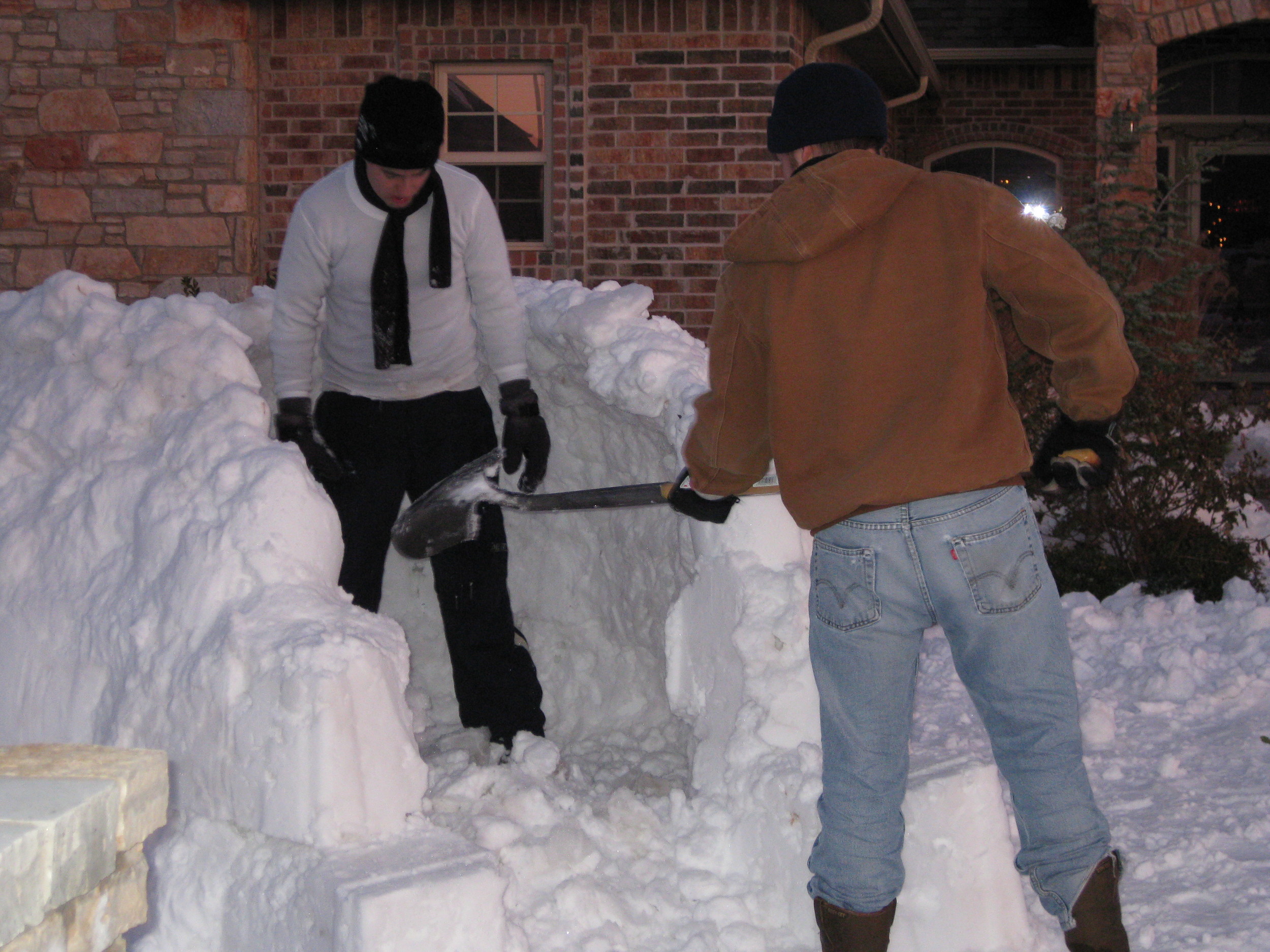
Our snow-loving boys built an igloo a few Christmases back. They finished it long after dark. The next morning Mimi, Karlee & Pops made a visit.

Make My Day

I'll admit it: I'm a fan of Catherine Townsend--well of her writing anyway. I don't know her personally although I would love to have coffee with her in a very public place (she scares me a little).

Her latest piece in The Atlantic, "How to Fight Like a Victorian Gentleman," is a great example of her writing skills, and it couldn't have come at a better time.

She starts like this: "It’s sundown at a small park in Burbank and I’m dressed in head-to-toe black, carrying a big stick and ready to street fight, Sherlock Holmes style."

Why is this important? At this point pretty much all my friends have been licensed to carry (a gun)--some in a "concealed" fashion, others right smack on their person, out there for everyone to see.

I'm honestly not sure why everyone has decided they need to bear arms. Is there some threat I don't know about that I could actually defend myself from if I were pistol-packin'? (Other than my armed neighbors who live in my "safe, gated community.")

Don't read this as bragging but: I've been to all five Boroughs of New York City, day and night. I've been to Chicago's north side and south side. I've been to the east side of St. Louis and Skid Row in Seattle, to Bourbon Street in New Orleans, to Washington D.C. and to Haight-Ashbury in San Francisco. I've been to Amsterdam, Paris France, and Venice Italy. I've even been to Muskogee, Oklahoma in the 60s with long hair and bell-bottom jeans, driving a VW bus.

And I've never feared for my life. Well there was that one time: a "lady" in Edmond, driving an enormous SUV, wearing yoga pants (I'm guessing) and doing something on her mobile phone was in front of me at a red light. The light changed, she didn't notice. I honked. She turned, flipped me off and said something with fire in her eyes. I couldn't read her lips because of the froth flying from her mouth. It was very scary.

Nippin' it in the bud.

Nippin' it in the bud.

Now, apparently there's a new threat in the air and I need to up my defense and offense somehow. The problem is I'm more of a Sheriff Taylor kind of guy, than a Barney Fife. Speaking of whom, I would be much more comfortable in the "safer" neighborhoods of our fair city if I knew that all the newly-armed citizens had only one bullet and that bullet had to be kept in their shirt pocket.

Somewhere in a closet we have a Red Ryder BB gun. I'm not sure which closet, and I have no idea where our BB might be, but that's all the arms-bearing I plan to do. I know right now there are some out there shaking their heads at my foolish naiveté. And they are appalled at my stupidity for posting to the worldwide web that me and my Amazing-Missus are home and unarmed.

But be not dismayed. I think I've found a solution in the words of my future friend, Catherine Townsend. In the aforementioned article, Catherine tells of her training in the ancient art of bartitsu. She explains it this way:

"Bartitsu was developed by Edward Barton-Wright, a British engineer who moved to Japan in 1895. After returning to London, just before the turn of the century, he created a mixed martial art hybrid, combining elements of judo, jujitsu, British boxing, and fighting with a walking stick.

The style was promoted to the middle and upper classes during a time when they were becoming increasingly worried about the street gangs and crime publicized by the tabloid newspapers."  

Catherine boils bartitsu down:

fight.jpg

Basically it's half historical recreation; half beating the crap out of someone with a cane.

Bartitsu is sort of cool. It was incorporated into the fight choreography of the Sherlock Holmes movies starring Robert Downey, Jr.

“There’s all sorts of locks and chokes and various other techniques used to incapacitate someone. There’s lots of throwing hats at someone’s eyes, and then striking at them, if you can, with a walking stick."

The movies helped propel what a bartitsu expert calls the “fringe of the fringe” movement into the spotlight, and attract a growing number of women. Googling will help you locate classes for guys with titles like: "Sparring With Sherlock," and for the girls: "Kicking Ass in a Corset: Bartitsu of Ladies."

Catherine read my mind and asked the obvious, important question: "But could an anachronistic art really protect me against a modern-day bad guy?" 

“Chances are your opponent isn’t going to be walking through the streets of a major world city twirling a parasol. But the classes do teach practical information about body awareness, how to target an opponent’s weak points and escape tactics that could come in handy in any situation."

So with a few lessons and a walking cane, we'll all rest better knowing I'm equipped for whatever it is that seems to be lurking in the night.