Once Upon An April 8th

Does the name Yorgos Kentrotas ring a bell? 

A while back, my Amazing-Missus reminded me of a great line that Ricky said to Lucy numerous times throughout their married-on-TV life: "You've got some splainin' to do."

I don't know Yorgos' actual story, but I'm guessing, based on mankind's long, long history of being caught red-handed, that he had some splainin' to do.

BTW: "To be taken with red hand" in ancient times was to be caught in the act, like a murderer with his hands red with his victim's blood. The use of red hand in this sense goes back to 15th-century Scotland and Scottish law. Sir Walter Scott's Ivanhoe (1819) contains the first recorded use of taken red-handed for someone apprehended in the act of committing a crime. The expression subsequently became more common as caught red-handed. --Encyclopedia of Word and Phrase Origins by Robert Hendrickson (Facts on File, New York, 1997), pp. 135-136 and 138.

You see, on this day, April 8th in 1820, Yorgos, a peasant farmer on the Aegean island of Milos found something while digging rocks from his field. It turns out it was the famous Ancient Greek sculpture the Venus de Milo (created between 130 and 100 BC).

Picture the scene. Yorgos comes home dragging this 6' 8" statue of Aphrodite herself. I'm guessing the first words out of Mrs. Kentrotas mouth were something like, "Where did you drag HER up from?"

It's that scene that has been around since the first junior high boy was caught with a "girlie" magazine. When you think about it, it goes back to the beginning with Adam and Eve and the whole "apple" conundrum. 

Weirdly enough, it was also on this day a few years back that the tele-evangelistic Jimmy Swaggart was defrocked for cavorting with prostitutes when he should have been converting them.

Not that there's really any connection between Yorgos, Junior-High boys, Adam and Jimmy Swaggert. Or is there?

This is just Pops having some fun with the events of April 8th.

Holy Cow!

WHILE I WILL ALWAYS BE A ST. LOUIS CARDINALS FAN, I will proclaim right here: there is no other baseball stadium; wait, make that any sports venue, anywhere, like the experience of Wrigley Field.

By the way, I'm not a Cardinals fan just because they are the most successful baseball franchise ever that don't wear pin-stopped uniforms. I am a fan because I grew up in Tulsa, and at the time, the Tulsa Oilers were a farm team for the Cardinals and all the Cards games were broadcast on KRMG radio in T-Town. I wrote about that in a post a while back called, Take Me Out To The Ballgame.

Back to Wrigley. Today was Opening Day for the Cubbies--their 100th at Wrigley!

That's a lot of Opening Days. No one knows better than Cubs fans that their team holds the record for the most consecutive seasons without winning a World Series. Still the place will be packed and rowdy. And every homerun ball hit in to the Wrigley stands by the opposing team will be hurled back on to field by the Cubs fan that caught. It's one of the things that makes Wrigley Wrigley.

The last time that our family attended a game at Wrigley was on a June 13th (my Amazing-Missus' birthday). It was one of Harry Caray's last years as the announcer for the Cubs. We looked forward to the 7th Inning Stretch when Harry would lean out of the press box and lead us in singing, "Take Me Out To The Ballgame..."

That night the Cubs and the Padres played through 14 innings. By that time, Harry had apparently enjoyed enough brewskies that I thought he might fall in to the seats below when he leaned out to lead us in another stanza during the 14th Inning Stretch. 

Fortunately for us, on that rare night in Wrigleyville we got to hear Harry exclaim at the end of the game: "Holy cow!" "Cubs win!"

Fans today were not so lucky. The Cubs lost to the Phillies 7-2. As I post this the Cards are playing that other Pennsylvania team. Go CARDS!

Can You See From Where You Are?

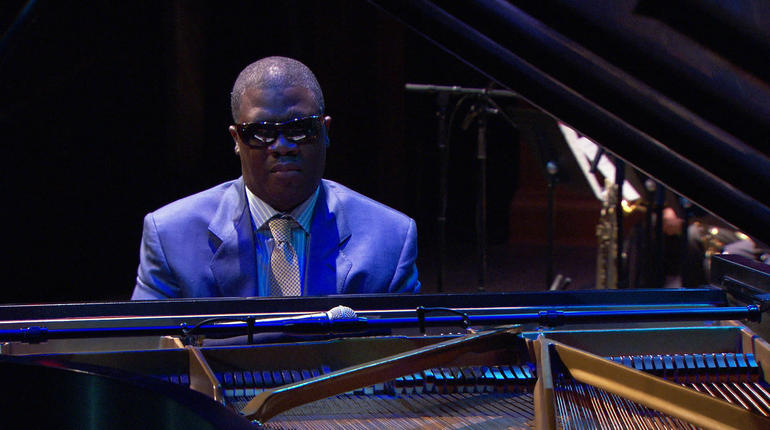
I HOPE YOU SAW the segment on 60 Minutes last Sunday night, reported by Wynton Marsalis. The segment was called The Virtuoso: Marcus Roberts. Here's a link to the video in case you missed it.

Marcus Roberts (CBS News)

Marcus Roberts (CBS News)

The story begins:

Marcus Roberts lost his sight as a child, but gained incredible insight into American music -- inspiring a generation of jazz musicians. Marcus went blind when he was 5 years old. And soon began trying to make sense of life in the darkness. He was unusually curious, and even tore his toys apart just to find out how they worked. Roberts developed a powerful, analytical intelligence, capable of producing music that will move your mind as well as your body. The story of his genius begins with a precious gift from his parents: a piano. His mother Coretta is sightless too, blinded by glaucoma. She remembers the pain of having to leave school in the seventh grade because she couldn't see the blackboard.

Don't you marvel? Think of these people who are sightless, but have such keen insight. One of those people, Helen Keller, reminds us that there is something worse than being sightless:

It is a terrible thing to see and have no vision. -- Helen Keller

I couldn't resist adding this photo of our grand-girl Harper. I don't know what she is imagining seeing through her "binoculars" (upside-down, no less), but clearly, whatever it is, is magnificent.

As we age, we seem to lose our vision. I'm not talking about our eyesight, although that happens too. But let's face it; we do NOT see the things a young child or a blind jazz musician does.

My dad will be 90 soon. He has lost most of his eyesight, but it seems to me like he "sees" more than he ever has, and he has always been an insightful man. So maybe there's hope for me. Maybe I won't become visionless. I want to look through the binoculars, or the camera, or the lament of the Blues, or a quiet Saturday morning enjoying a good, strong cup of coffee and the company of my Amazing-Missus, and SEE something I've never seen before.

And ultimately, there is that promise. Remember the verse? “Eye hath not seen, nor ear heard, neither have entered into the heart of man the things which God hath prepared for them that love Him.” 

Several years ago now, death came way too soon for my cousin, "Bobby." He always had a toughness and swagger than I admired as a little kid looking up to him. He seemed to see things I couldn't. At his memorial service, he wanted a certain song played. I've never heard it played at a funeral since. Maybe it was just apropos for Bobby. It goes like this:

I can see clearly now, the rain is gone, 
I can see all obstacles in my way 
Gone are the dark clouds that had me blind 
It’s gonna be a bright, bright 
Sun-Shiny day. 

I think I can make it now, the pain is gone 
All of the bad feelings have disappeared 
Here is the rainbow I’ve been praying for 
It’s gonna be a bright, bright 
Sun-Shiny day. 

It's Okay

I realize I'm a few weeks late in recognizing the birthday of this word, one which has been called the most enduring word of American descent. It is the word okay. Yes, okay; or OK. It is now 175 years old.

One of my favorite journalists, Mo Rocca, reporting on my favorite network news-magazine, CBS Sunday Morning, did a wonderful story on the history of the word. You can find the video here.

But why am I bringing it up now? Well, while Mo does acknowledge that in the history of the word OK is the story that it comes from the Choctaw word "Okeh" which means, "it is so," he doesn't talk about its significance for us who live in Oklahoma.

from the daily artifact project

from the daily artifact project

Saturday, my Amazing-Missus and I were at a local nursery. We decide to replace some of the high-maintenance stuff in our landscape with not-high-maintenance stuff. A young horticulturist named Zack was assisting us. In the conversation we learned that Zack was born and raised in Southern California. As he was recommending trees and shrubs for us to consider, Zack said something about Oklahoma's very varied weather. I explained to him that these patterns are called "seasons". You have to explain these kinds of things to southern Californians.

We chose nandinas, a crepe myrtle, and a red bud tree. Zack said, "Those are very Okie selections." What he meant was these are things that know how to live and thrive in Oklahoma.

It struck me that what applies to plants also works for other living things--like people. Will Zack ever make it here? He'll probably survive, but he may not thrive. You don't seen many palm trees in these parts. And if you do, they're probably made of sheet metal.

Even among us Okies, different "species" thrive. We are a diverse group, a colorful tapestry. It's OKAY. Did you know that Oklahoma has more eco-regions than any other state? And we are as different as our ecology, our politics, our theology and cultural leanings. And I'm OK with that. 

We know we belong to the land
And the land we belong to is grand
And when we say
Yeow! A-YIP-I-O-EE-AY
Were only say-in "you're doing fine Oklahoma,
Oklahoma OK!
--Rodgers & Hammerstein