AUTUMN LEAVES

IT WAS AROUND 1968, The Zombies sang about a "Time of the Season". The song asks:

What's your name? (What's your name?)
Who's your daddy? (Who's your daddy?)
(He rich?) Is he rich like me?

The song has little to do with the crux of the matter of this post. (If there is a crux to this one.) (As I'm typing, this feels like just putting words out there about something/anything, to avoid saying out loud those words that weigh most heavy.)

So let's get to that crux--the essence: Autumn is my favorite season, and it starts today: Monday, September 22, 2025, at 1:29 CDT here at About Pops HQ. Although, with a forecast high of 90, it's not feeling like sweater-wearing season just yet.
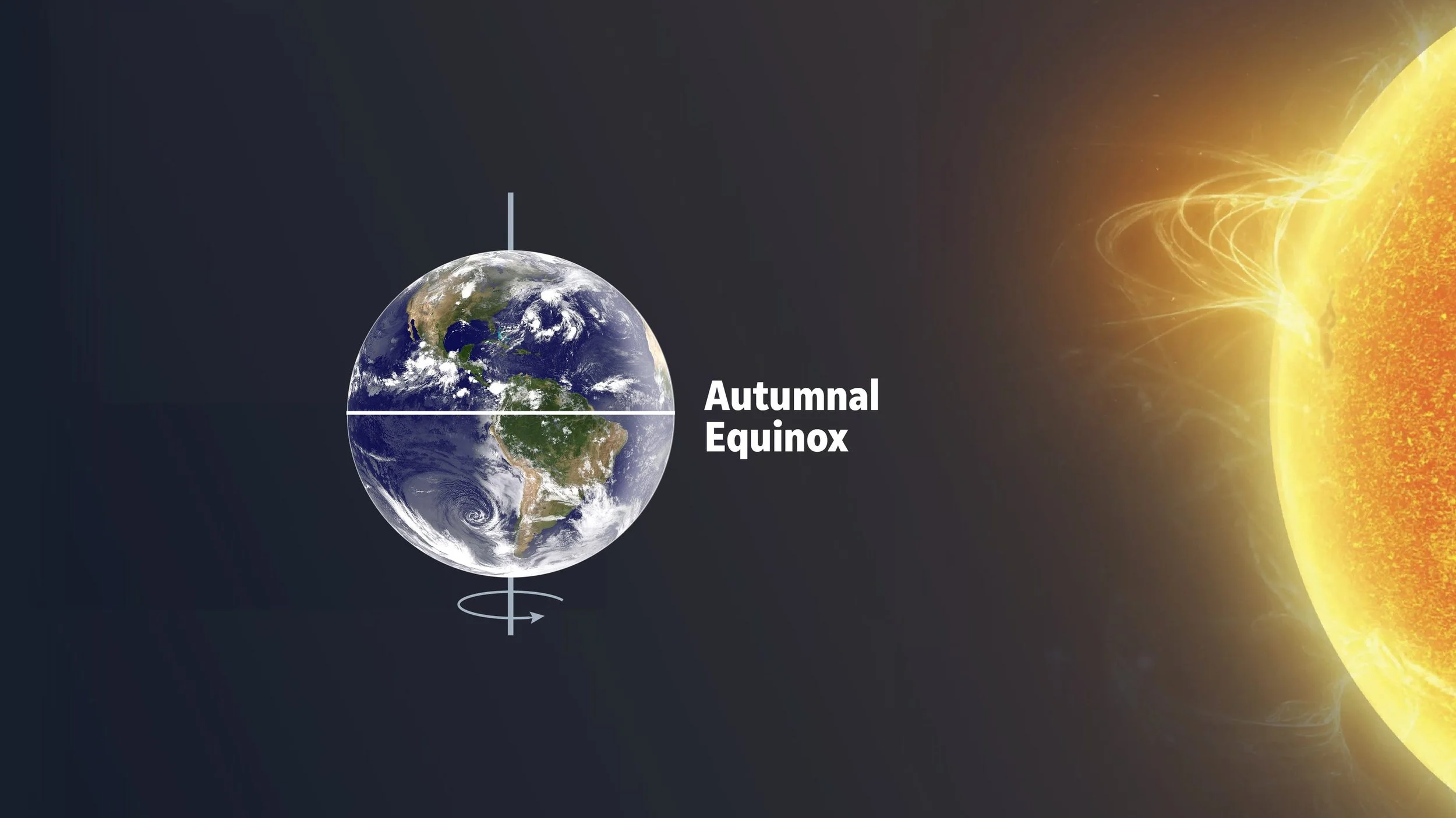
The Autumnal Equinox is the time where the hours of sunlight and darkness are roughly the same. I'm not crazy about the days getting shorter, especially now when it feels like our cultural darkness grows longer and deeper. It is true that the darkest hour is just before dawn, and now dawn will be taking its sweet time bringing light and hope and newness each day. But, like that little girl sang: "The sun'll come out tomorrow."

Fall reminds me of one of my favorite songs. It's one of the "standards" as the music industry says. It's called "Autumn Leaves". It paints a picture, as good lyrics always do. We see the epitome of Autumn, not a pumpkin-spiced latte, but the leaves of red and gold. We're reminded of summer's passing and time marching on. With a twist: even though the daylight hours grow shorter, somehow the days grow long.

Since you went away the days grow long
And soon I'll hear old winter's song
But I miss you most of all my darling
When autumn leaves start to fall

Here's a little background to save you the googling:

"Autumn Leaves" is the English-language version of the French song "Les Feuilles mortes" ("The Dead Leaves") composed by Joseph Kosma in 1945. The original lyrics were written by Jacques Prévert in French, and the English lyrics were by Johnny Mercer. An instrumental recording by pianist Roger Williams was a number one best-seller in the US Billboard charts of 1955. --Wikipedia

Since its introduction "Autumn Leaves" has become one of the most recorded songs by jazz musicians. More than a thousand commercial recordings are known to have been released by mainstream jazz and pop musicians. I've played in a few jazz bands in my days and in each and everyone "Autumn Leaves" was on the set list. It has been arranged and rearranged in so many styles that it can sound like many different songs, but always with that haunting melody. One of my favorite versions is by the jazz pianist Bill Evans.

For a different take on it, listen to this YouTube video of it being played by a drum and bugle corp —The Bluecoats— who have made the song their official anthem. CLICK HERE FOR A LISTEN.

NOW FOR MY FAVORITE: This is a live recording of Eva Cassidy. She was in her young 30s at this performance. She died of cancer not too long afterward. When you watch this and hear her sing I think you'll agree with me that's it's almost like the song was written to be sung by her. CLICK HERE TO SEE EVA’S VIDEO.

Happy Autumn All. Enjoy. The Winter Solstice will be here soon when Autumn leaves until next year.
HORIZON

THERE WAS A TIME when I could water ski. Today, with arthritic hands and carrying extra ballast, I doubt that I could hold on to the rope tight enough and long enough to pop out of the water. That's okay. I have no desire to be on skis anyway. It's not the proverbial sour grapes; I've moved on to other thrilling endeavors--like reading a newspaper or two each morning and tuning in to hear of the latest antics from D.C. Sometimes that feels like trying to hold on tight while being dragged face-first through the wake of long boat powered by two big Evinrudes.

I loved being around my Uncle David. He was oh so funny and fun. I remember being his caddy for a few rounds of golf when I was a kid. One summer, during college, I worked in his concrete construction company. But the best memory of all was going sailing with him on his sailboat. Skimming across the water without the roar of engines or the smell of fuel exhaust, the sails full of wind; this was the boating life for me. That day I vowed that one day I would have a sailboat.

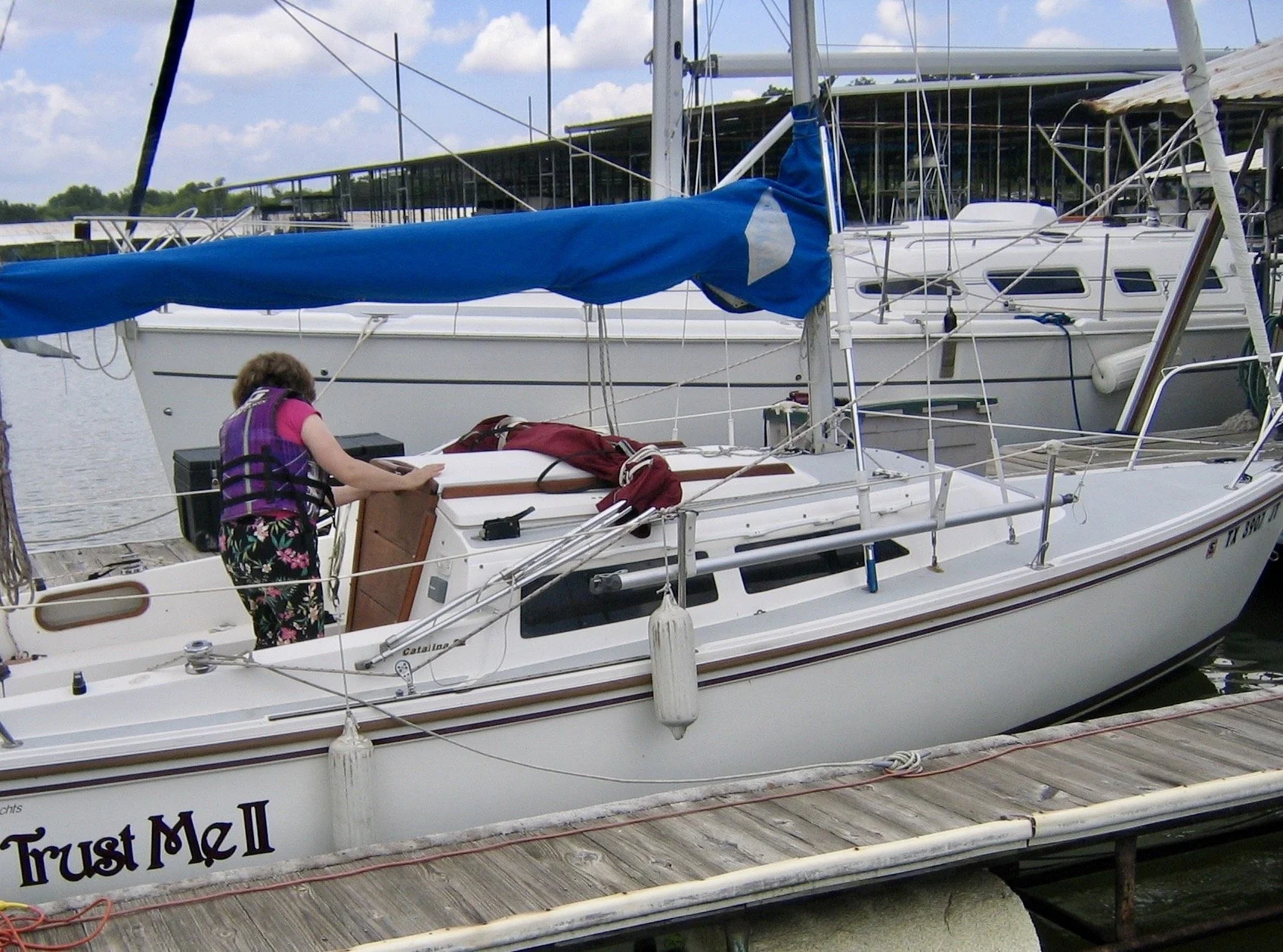
Decades later, My Amazing Missus and I set sail for the first time on our Catalina sailboat, named (by the previous owner) "Trust Me II". People often asked, "What happened to Trust Me I?" I would explain that I covered that in my marriage proposal to her.

my amazing missus battening down the hatchs after a sail aboard trust me II

Sailing and marriage do take some trust; and repentance and forgiveness and courage and teamwork. You have to balance the white-knuckling, fraught, terrifying moments of changing winds and choppy waters with those that are blissful, serene and sublime. Occasionally, in precarious sailing moments, I would remind her and myself that I had three sailing certifications including costal cruising and navigation. But certificates don't matter when the boat is heeled over, keel up, and on the edge of its beam, speeding across the waves. The combination of thrills and terrors demands a return to calm. So a gentle turn into the wind puts on the brakes.

Once nerves and winds calmed, I might quote Captain Jack Sparrow just to reassure her: "The seas may be rough but I am the Captain! No matter how difficult, I will always prevail." She would give me a look as if to say, "Whatever floats your boat 'Captain'."

In the first sailing class you learn that a boat under sail (no engine running) always has right-of-way over a "power" boat. I raised my hand and asked the instructor if a guy with a six-pack or so of refreshing beverage in him, driving his boat full throttle across the lake, is aware of that rule. "Absolutely not!" our instructor warned.

Moral: You can know the rules, you can seek to follow the rules, but watch out for the guy whose t-shirt reads: Boats-Booze-Babes.

It feels like these days, the rules made by men are applied arbitrarily and only as they suit the desired ends of the power-brandishers. But when it comes to the ultimate, unshakeable rules of nature: the winds and the waves will have the final say.

A bit of sailing wisdom from a crusty old sailor named Scully, who ran a floating seafood joint/sailboat rental on a decrepit ship called the "Barnacle", to a guy named Jack (played by John Candy) renting a sailboat in a movie called "Summer Rental".

Scully:
She'll make ya rich, or she'll feed ya to the fishes. If she wants you to dance, sonny boy, you've got to follow her lead.

Jack:
Didn't I read that on your bathroom wall?

Scully:
Yes. And it's as true today as when I hung it there.

There was a guy whose boat's home slip was near ours. Even when he wasn't sailing, often times you could find him on his boat there at the dock, maybe doing some cleaning or straightening up the lines. Sometimes he would be sitting, reading and smoking his pipe. When we would pass by whether going out to sail or returning home he would say: "Fair winds and following seas." It's apparently a sort of sailor's blessing for well wishes. If you've been on a sailboat, it rings true. It's something I long for at this stage of the journey.

Once more, a quote from the quotable Captain Jack Sparrow: "The problem is not the problem. Your attitude about the problem is the problem."

I know, I know, Captain Jack. But these days it sure seems like the problem is the problem.

You've probably heard someone say, "This too shall pass." It's a very future focused sentiment isn't it? While I tend to get mired in the muck of the moment, I'm fascinated by that thing artists call the horizon line. Being on the water makes the horizon line so clear and straight. Depending on where the line is--high or low--in a picture, it gives us the feeling of being near or far from that moving target of a line. And even though it keeps its distance from us we still move toward it and all that it promises; over there beyond the horizon.

Now bring me that horizon.
— Captain Jack Sparrow

Billy Collins is one of my favorite poets and one of his poems that I've been reading a lot lately is "Aristotle". Each time we would go on a sail, there was a pushing from the dock and raising of the sails--a beginning. There was middle part--the adventure, the fun, the drama. And there was the return to the harbor and the routines of life. Mr. Collins in this poem pays homage to Aristotle's observations of well-told stories having a beginning, a middle and an ending. So, I'm thinking for a moment about each of our stories and our Story.


Aristotle
BY BILLY COLLINS

This is the beginning.
Almost anything can happen.
This is where you find
the creation of light, a fish wriggling onto land,
the first word of Paradise Lost on an empty page.
Think of an egg, the letter A,
a woman ironing on a bare stage
as the heavy curtain rises.
This is the very beginning.
The first-person narrator introduces himself,
tells us about his lineage.
The mezzo-soprano stands in the wings.
Here the climbers are studying a map
or pulling on their long woolen socks.
This is early on, years before the Ark, dawn.
The profile of an animal is being smeared
on the wall of a cave,
and you have not yet learned to crawl.
This is the opening, the gambit,
a pawn moving forward an inch.
This is your first night with her,
your first night without her.
This is the first part
where the wheels begin to turn,
where the elevator begins its ascent,
before the doors lurch apart.

This is the middle.
Things have had time to get complicated,
messy, really. Nothing is simple anymore.
Cities have sprouted up along the rivers
teeming with people at cross-purposes—
a million schemes, a million wild looks.
Disappointment unshoulders his knapsack
here and pitches his ragged tent.
This is the sticky part where the plot congeals,
where the action suddenly reverses
or swerves off in an outrageous direction.
Here the narrator devotes a long paragraph
to why Miriam does not want Edward's child.
Someone hides a letter under a pillow.
Here the aria rises to a pitch,
a song of betrayal, salted with revenge.
And the climbing party is stuck on a ledge
halfway up the mountain.
This is the bridge, the painful modulation.
This is the thick of things.
So much is crowded into the middle—
the guitars of Spain, piles of ripe avocados,
Russian uniforms, noisy parties,
lakeside kisses, arguments heard through a wall—
too much to name, too much to think about.

And this is the end,
the car running out of road,
the river losing its name in an ocean,
the long nose of the photographed horse
touching the white electronic line.
This is the colophon, the last elephant in the parade,
the empty wheelchair,
and pigeons floating down in the evening.
Here the stage is littered with bodies,
the narrator leads the characters to their cells,
and the climbers are in their graves.
It is me hitting the period
and you closing the book.
It is Sylvia Plath in the kitchen
and St. Clement with an anchor around his neck.
This is the final bit
thinning away to nothing.
This is the end, according to Aristotle,
what we have all been waiting for,
what everything comes down to,
the destination we cannot help imagining,
a streak of light in the sky,
a hat on a peg, and outside the cabin, falling leaves.


Fair winds and following seas to you and yours.

IN PURSUIT

I’M NOT SAYING that the pursuit of peace is insignificant or unworthy, just slipping toward insincere, or so it seems; but vital and essential.

Cynicism has always been in the battered bag of things that I allow to trip me up. Accelerating age seems to deepen and thicken it, along with my anger over prescription medicine advertisements on TV.

Still, I remain hopeful that peace in our hearts, in our families, and in our relationships will grow and grow. I would like to be optimisic about world peace but that nagging cynicism won't let me go there; particularly when the Pursuit of Peace is stamped official by being screenprinted on a backdrop behind high-positioned folk. So it seems the mission is handed over to those in pursuit of other things like power, domination, supremacy, or whatever satisfies their base hunger and lusts. All that just seems contrary to peace pursuance.

There are some things that some people may be ill-suited for, or maybe they're being dishonest with themselves, or maybe they are dishonest and just nearly-to-completely self-serving--their narcissism has killed any seed of imagination. Maybe, for example, someone wants a medal for peace-making so badly that they will cook up a crock of drama, masquerading as the greatest maker of peace of all the peace-makers ever.

It would be sort of like putting me in charge of guarding a cooling batch of no-bake cookies. I may boast of being a cookie guardian, but when it comes to keeping my hand out of the cookie jar, I'm weak, insatiable and lacking any moral backbone whatsoever. And there's a darker corner in here that makes me apathetic about whether anyone else gets a cookie or not.

Every single day I wear a Peace Sign pendant. I know all the words to John Lennon's song "Give Peace A Chance". One of my favorite passages is from the book of First Peter, chapter 3:

Whoever wants to embrace life and see the day fill up with good, Here’s what you do: Say nothing evil or hurtful; Snub evil and cultivate good; run after peace for all you’re worth.
— 1 Peter 3:10-11. The Message.

My favorite of the Beatitudes is #7: Blessed are the peacemakers, for they will be called children of God. --Matthew 5:9

Does all that make me a peace-maker? Not any more than wearing a badge that says, "ICE: International Cookie Enforcer" and telling people that I love cookies even more than Cookie Monster himself makes me a worthy guardian of the no-back cookies cookie jar.

Some may sense a tinge of hypocracy here: me acting like a peacenik while throwing little rocks at those who have the power to end conflicts but don't. Guilty your honor(s).

So how does one become a maker, sustainer, propagator and keeper of peace?

The wisdom seems to be in that verse: "Say nothing evil or hurtful; Snub evil and cultivate good; run after peace for all you're worth." After all; who doesn't want to "embrace life and see the day fill up with good"?

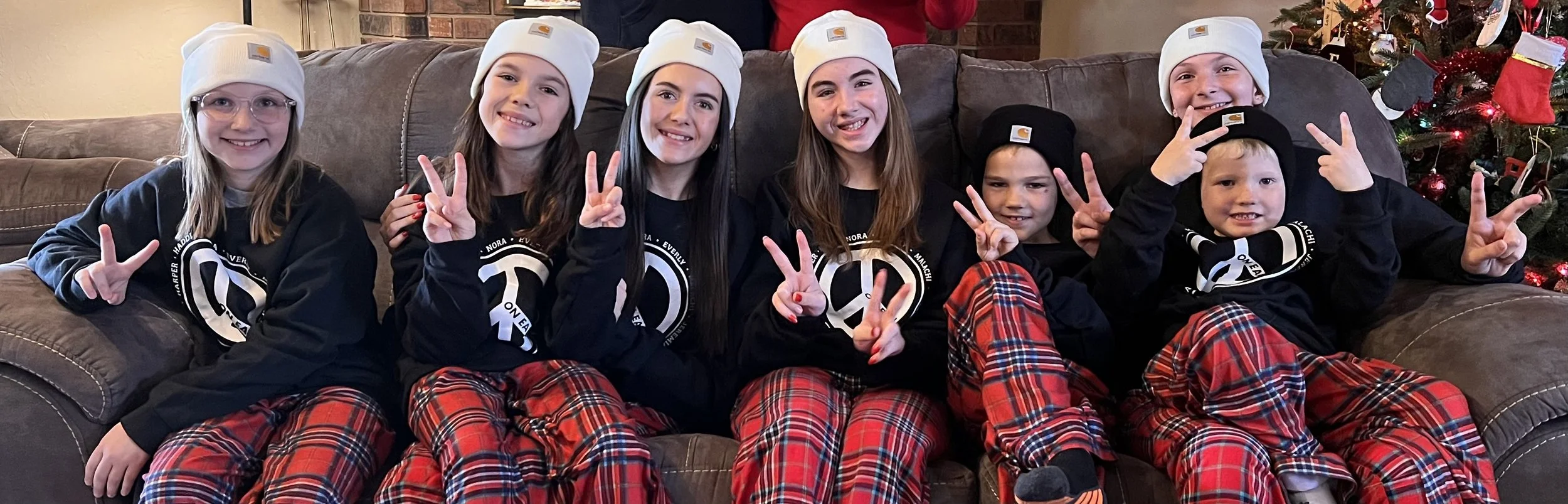
Here's a shot of Our Grands, last Christmastime, that season when we sing and remember the story about "Peace On Earth"! [Trying to pass my belief in the goodness, truth and beauty of PEACE on to the next generation.]

PEACE to you and yours.

Notes on the day

[I’m leaving these notes on thoughts and observations here, not so much as a blog post but to give them a place of record for today July 26, 2025.]


Let’s be clear here. Ghislaine Maxwell didn’t testify with Todd Blanche. She negotiated.
— Brian Tyler Cohen

FACT #1. Ghislaine Maxwell is a convicted child sex offender, guilty of child sex trafficing.

FACT #2. Her partner in crime was Jeffrey Epstein, also convicted and dead by suicide while under close watch in jail.

FACT #3. Epstein and Maxwell were close to Donald Trump and spent time together. The extent of the relationship is now under scrutiny and debate.

Ghislaine Noelle Marion Maxwell is a British former socialite and a convicted sex offender. In 2021, she was found guilty of child sex trafficking and other offences in connection with the deceased financier and convicted sex offender Jeffrey Epstein. The following year, she was sentenced in federal court in New York City to 20 years of imprisonment. --Wikipedia

FACT #4. As a part of "being transparent" the Trump administration sent Deputy Attorney General Todd Blanche to interview Maxell.

President Trump’s former personal attorney-turned-Justice Department deputy of Trump's justice department to interview Maxwell in prison.

FACT #5. The only people present for the interview were Maxwell, Blanche and her attorney David Markus, who has been representing her during her legal proceedings, including her appeal against her conviction for sex trafficking.

FACT #6. Todd Blanche and David Markus are friends.

Blanche announced that he would initiate talks with a lawyer for Ghislaine Maxwell, disgraced financier Jeffrey Epstein’s accomplice. Left unmentioned: The lawyer, David Oscar Markus, happens to be a friend of Blanche.

“I know a lot of people that have worked with you. I know a lot of people who know you very well,” Blanche told Markus last year while appearing for an hourlong sitdown on his podcast. “I now consider you a friend and someone who I know pretty well,” Blanche added. “You are—by far, are—the best out there.” --The Hill

FACT #7. There were no other witnesses to the interviews. Only Maxwell and the two lawyer friends were present.

Senate Minority Leader Chuck Schumer writing on X: “Under no circumstances should anyone from Trump’s DOJ be allowed to privately interview Ghislaine Maxwell."

FACT #8. Neither the justice department or Trump have announced that there will be interviews granted to the victims of the pedophiles deeds.

President Donald Trump did not rule out the possibility of pardoning Jeffrey Epstein associate Ghislaine Maxwell on Friday, July 25, 2025—saying he hadn’t “thought about” the possibility but is “allowed” to pardon her—as Maxwell’s interview with Justice Department prosecutors this week has sparked new questions about whether the Trump administration could offer her a pardon in exchange for exonerating the president from Epstein’s crimes. --Forbes

FACT #9. Would Trump actually consider something so repulsive and clearly self-serving as to pardon her? Of course he would. He's given pardons to criminals and cop killers.

FACT #10. Surely, justice would demand, that if Trump were to give Maxwell a pardon or any consideration at all like a reduced sentence, he would be included as an accomplice or co-conspirator to those crimes.

Remember on January 2016, presidential candidate Donald Trump caused controversy when he stated the following during a campaign rally in Iowa: "I could stand in the middle of 5th Avenue and shoot somebody and I wouldn't lose voters."

Obviously he's right about that--given what we've seen. But surely knowingly participating in sex trafficing of minor girls would be a bridge too far.