
Can You See From Where You Are?

I HOPE YOU SAW the segment on 60 Minutes last Sunday night, reported by Wynton Marsalis. The segment was called The Virtuoso: Marcus Roberts. Here's a link to the video in case you missed it.
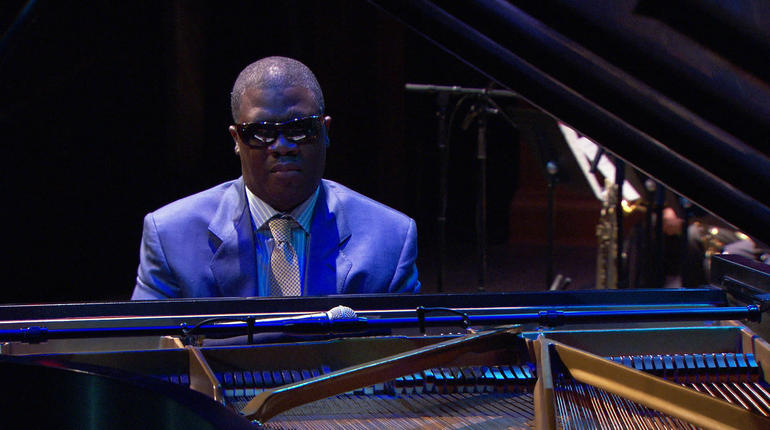
Marcus Roberts (CBS News)

Marcus Roberts (CBS News)

The story begins:

Marcus Roberts lost his sight as a child, but gained incredible insight into American music -- inspiring a generation of jazz musicians. Marcus went blind when he was 5 years old. And soon began trying to make sense of life in the darkness. He was unusually curious, and even tore his toys apart just to find out how they worked. Roberts developed a powerful, analytical intelligence, capable of producing music that will move your mind as well as your body. The story of his genius begins with a precious gift from his parents: a piano. His mother Coretta is sightless too, blinded by glaucoma. She remembers the pain of having to leave school in the seventh grade because she couldn't see the blackboard.

Don't you marvel? Think of these people who are sightless, but have such keen insight. One of those people, Helen Keller, reminds us that there is something worse than being sightless:

It is a terrible thing to see and have no vision. -- Helen Keller

I couldn't resist adding this photo of our grand-girl Harper. I don't know what she is imagining seeing through her "binoculars" (upside-down, no less), but clearly, whatever it is, is magnificent.

As we age, we seem to lose our vision. I'm not talking about our eyesight, although that happens too. But let's face it; we do NOT see the things a young child or a blind jazz musician does.

My dad will be 90 soon. He has lost most of his eyesight, but it seems to me like he "sees" more than he ever has, and he has always been an insightful man. So maybe there's hope for me. Maybe I won't become visionless. I want to look through the binoculars, or the camera, or the lament of the Blues, or a quiet Saturday morning enjoying a good, strong cup of coffee and the company of my Amazing-Missus, and SEE something I've never seen before.

And ultimately, there is that promise. Remember the verse? “Eye hath not seen, nor ear heard, neither have entered into the heart of man the things which God hath prepared for them that love Him.” 

Several years ago now, death came way too soon for my cousin, "Bobby." He always had a toughness and swagger than I admired as a little kid looking up to him. He seemed to see things I couldn't. At his memorial service, he wanted a certain song played. I've never heard it played at a funeral since. Maybe it was just apropos for Bobby. It goes like this:

I can see clearly now, the rain is gone, 
I can see all obstacles in my way 
Gone are the dark clouds that had me blind 
It’s gonna be a bright, bright 
Sun-Shiny day. 

I think I can make it now, the pain is gone 
All of the bad feelings have disappeared 
Here is the rainbow I’ve been praying for 
It’s gonna be a bright, bright 
Sun-Shiny day. 

It's Okay

I realize I'm a few weeks late in recognizing the birthday of this word, one which has been called the most enduring word of American descent. It is the word okay. Yes, okay; or OK. It is now 175 years old.

One of my favorite journalists, Mo Rocca, reporting on my favorite network news-magazine, CBS Sunday Morning, did a wonderful story on the history of the word. You can find the video here.

But why am I bringing it up now? Well, while Mo does acknowledge that in the history of the word OK is the story that it comes from the Choctaw word "Okeh" which means, "it is so," he doesn't talk about its significance for us who live in Oklahoma.

from the daily artifact project

from the daily artifact project

Saturday, my Amazing-Missus and I were at a local nursery. We decide to replace some of the high-maintenance stuff in our landscape with not-high-maintenance stuff. A young horticulturist named Zack was assisting us. In the conversation we learned that Zack was born and raised in Southern California. As he was recommending trees and shrubs for us to consider, Zack said something about Oklahoma's very varied weather. I explained to him that these patterns are called "seasons". You have to explain these kinds of things to southern Californians.

We chose nandinas, a crepe myrtle, and a red bud tree. Zack said, "Those are very Okie selections." What he meant was these are things that know how to live and thrive in Oklahoma.

It struck me that what applies to plants also works for other living things--like people. Will Zack ever make it here? He'll probably survive, but he may not thrive. You don't seen many palm trees in these parts. And if you do, they're probably made of sheet metal.

Even among us Okies, different "species" thrive. We are a diverse group, a colorful tapestry. It's OKAY. Did you know that Oklahoma has more eco-regions than any other state? And we are as different as our ecology, our politics, our theology and cultural leanings. And I'm OK with that. 

We know we belong to the land
And the land we belong to is grand
And when we say
Yeow! A-YIP-I-O-EE-AY
Were only say-in "you're doing fine Oklahoma,
Oklahoma OK!
--Rodgers & Hammerstein


The Prom & Taxes

"March Madness" is near completion. Judging from the wailing and gnashing of teeth from people carrying their "brackets" through the halls at work, "mad" is apt.

The Scream. Edvard Munch

The Scream. Edvard Munch

Does March mind being Mad? What if every month had an emotion, feeling or sentiment attached to it. The little month of February certainly does.

If I were King for a day, or the Pope, or Oprah... I would proclaim: ANGST APRIL!

The thought first hit me as my Amazing-Missus and I strolled the huckster-lined aisles of the OKC Home & Garden Show. I tried to make the occasion more romantic than it could ever be by imagining it is an old street market, but instead of vendors at their carts selling fruit, flowers or fish, they were proclaiming the virtues of vinyl siding, waterless cookware and something called a "Sham-Wow."

They were using marketing tricks older than Freud's "Pleasure Principle. I mentioned it a few blog posts back. The thought is, that for us mortals it all comes down to instinctively seeking pleasure and avoiding pain. Jeremy Bentham agreed, "Nature has placed mankind under the governance of two sovereign masters, pain and pleasure".

Few places can you see it side-by-side better than at this show. Littered throughout were displays of hot tubs and spas with posters depicting a viagra-gorged guy with at least two former Miss-Somethings, lounging joyously with glasses of wine sitting in built in cup holders. And then, in the very next display, storm shelters with large posters of bedraggled people combing through the wreckage of the Moore and El Reno tornados.

Few things motivate like the promise of pleasure and the potential in fear. Remember the videos of car wrecks they made us watch in Driver's Ed. I still have nightmares about the pictures that were in the textbook for the scuba diving class I took in college. And who can forget revival time at church when we were kids. They would entice us all to come for "Children's Night" with all-you-can-eat hot dogs. Then they would march us to the service where the evangelist would scare us into submission by "holding us over hell like one of those weenies on a stick."

So what is angst? From www.urbandictionary.com:

Angst, often confused with anxiety, is a transcendent emotion in that it combines the unbearable anguish of life with the hopes of overcoming this seemingly impossible situation. Without the important element of hope, the emotion is anxiety, not angst. Angst denotes the constant struggle one has with the burdens of life that weighs on the dispossessed and not knowing when the salvation will appear.

To me, April brings more angst than any other month. I'll prove it with two words: April Fifteenth! Angst is right for April because, in the eye of it's threatening storm, is the hopeful promise of new buds and fresh starts.

April has always been ominous. Seriously; what life event packs more angst (and we're talking teen angst now; the worst kind) than the high school prom. The whole thing: finding a date, that corsage, the expense, the tux, the picking her up, the dancing, did I mention the expense? Then there's the whole angst-filled after-prom thing. It's all sweaty pits and palms and potential-where does the relationship go from here.

How powerful is angst? just think how much of our music is dedicated to it. Here's a sample. And while this is not a prom scenario per se; well you get the point.

IT'S MY PARTY
By Lesley Gore

Nobody knows where my Johnny has gone
Judy left the same time
Why was he holding her hand
When he's supposed to be mine

It's my party, and I'll cry if I want to
Cry if I want to, cry if I want to
You would cry too if it happened to you

Playin' my records, keep dancin' all night
Leave me alone for a while
'Till Johnny's dancin' with me
I've got no reason to smile

Judy and Johnny just walked through the door
Like a queen with her king
Oh what a birthday surprise
Judy's wearin' his ring

It's my party, and I'll cry if I want to
Cry if I want to, cry if I want to
You would cry too if it happened to you 

HAPPY ANGST APRIL EVERYONE!

Feeling Pretty Self-Actualized If I Do Say So Myself

I'LL ADMIT IT. One of the scariest aspects of being a "man of a certain age" is the fear that I've reached THE END. Not the physical end, but that place old guys seem to come to where they stop growing; again, not in a physical sense, but as a person. You know what I mean: they think they've seen it all, heard it all and know it all. They "arrived"!

Maybe what's so scary about that for me is thinking that if I have arrived, then this is all I have to offer--that I've become all I can become except a cranky, old, dogmatic, Fox-News watching, horses's a-double-s.

When I was first introduced to the idea of "self-actualization" (especially Abraham Maslow's take on it) back in college, it rang very true for me. Without going in to the whole concept, let's overly narrow it down to this: Think of a continuous line, like a ruler. On one end is our Potential. On the other is our Actual. So, if I become a healthy self-actualized adult, it means, very simply, that I've moved along the scale from potential to actual. By the way, Maslow speculated that less than 1% of the population ever becomes fully self-actualized.

I hope, I HOPE, that during this era that I like to call my "second-coming of age", I will realize brand new, deeper and more significant potentials I can pursue.

But wait. Let me get my horse and cart in the right order. There are a couple of issues I need to clarify.

One: for those of you who are saying to yourself (as if anyone is still reading this), "I knew this guy was a 'secular humanist' all along. Just listen to this drivel," you're not the first.

Back in the day, I had a job as a teacher/consultant of sorts for people who worked with adolescents in churches. I would frequently use Maslow's Hierarchy of Needs to talk about what can happen as a teen develops. One time I was leading a conference for youth leaders in southeastern Oklahoma. A man came in to the conference wearing a snappy pair of white patent leather loafers and matching belt (think: Cousin Eddie) and introduced himself as "Pastor Roy Somethingorother." When I asked Pastor Roy why he had chosen to come to a conference for youth leaders he told me that he was only there to monitor what I had to say, to make sure I was not a "humanist."

All during the meeting I noticed him making notes in a miniature stenographers notebook like a reporter at a Whitehouse briefing. I expected at any moment for him to jump to his feet and shout, "Bingo, we've got ourselves a heretic!" He never did, and I never heard anything from Roy or whomever he was representing. Maybe he was just taking notes for his next sermon.

I do believe that we are created in the image of a creative God to be fully human. If that makes me a humanist, so be it.

Next: there is the big question of knowing what our potential is. Remember that line, our continuum, with POTENTIAL on one end and ACTUAL on the other? Before we can actually reach our POTENTIAL we need to know what it is. But where do we find that out?

Back when I was a kid, our report cards from school had a place for the teacher to record, in her opinion, whether or not we were "performing up to our potential." There was a consensus among my teachers that I was "NOT." There may have been one exception to that, my fourth grade teacher, even though she did check the "needs to improve" box.

Recently around our house, we've been going through some old stuff: treasures, photos, heirlooms, etc. In one of the boxes I ran across old report cards my mother had saved; although I'm not sure why unless she wanted to show them to parents of troubled kids to demonstrate there's always something to hope for.

Attached to my final fourth grade report card was a note from my teacher to my parents.

[If you can't read the letter in this image, I've included the text of it below.]


I'm glad that I didn't see this letter until 50-plus years later. It could have become a self-fulfilling prophecy of sorts had I seen it at the time. Instead, I like to imagine it as some sort of destiny.

I take heart that I helped make my teacher's career more pleasant. I like that she picked up on and commended my "gay outlook to everything," (I'm taking that to mean the 1960 definition of the word. Not that there's anything wrong with a more 2000s definition.) I am also relieved to note that my teacher apparently only owned a red ink pen and it wasn't just that all of my papers were graded in red. I liked the way she pretended to struggle with the proper use of  the are/is  verb form and its agreement with "Boys" or "David" just to make the rest of us feel good.

But I am most proud that Mrs. Burchette noticed, early on, a POTENTIAL for a sense of humor and that even THAT could take me "far in life." And, although I'm sure my parents had rather read something like, "He has the intellect of a rocket scientist", I feel SO self-actualized.

So, when my Grand-Girls say, "You're funny Pops," I think to myself, "Yes! Yes I am!" Thank you Mrs. Burchette, wherever you are.


Text of the letter:

The Fullers,

It was a pleasure having David in my room this year. Boys like David are what make a teacher's career pleasant. He always seems to have a gay outlook to everything.

It was also nice meeting and talking with you. I want to thank you for all the help you gave me in working with David.

He is a boy to be proud of and with his sense of humor he will go far in life.

Mrs. Burchette