
A Life, A Rhapsody

I’m not the first to draw an analogy between a life lived and a composition. One of my favorite examples is from “Mr. Holland’s Opus”, a movie I wrote about here. Mr Holland was the band director of a high school for many years. In a scene toward the end of the movie, one of his former students, Gertrude Lang is speaking at an assembly given to honor him:

“There is not a life in this room that you have not touched, and each of us is a better person because of you. We are your symphony Mr. Holland. We are the melodies and the notes of your opus. We are the music of your life.”

What a wonderful tribute. What a beautiful metaphor for a life’s story.

In 1924, George Gershwin composed “Rhapsody In Blue.” It is a classic. It was the hallmark of music scored for orchestra written in jazz forms of the 20s. A rhapsody, and particularly “Rhapsody In Blue”, is characterized by its range of emotion and tonal qualities along with a feeling of improvisation, but with a recurring theme.

A rhapsody is literally an epic poem, written in one movement, recited or played from start to finish. 

I want to tell you of a story of a boy. To me this boy’s life is a rhapsody.

This boy grew up in Lincoln Parish, north central Louisiana, in a little town called Dubach (dew-bach). It was clear to all that love and loyalty for family would be a theme of his life.

I didn’t know him as a boy, but I know from the stories I’ve heard that he made the most of every life experience and relationship. His stories are rich and humble. In fact there is a humility that everyone who knows him, knows is genuine.

There are some things I know for sure about him. He loves music. He was a musician himself. He played the clarinet. I think it’s interesting that “Rhapsody In Blue” starts with a clarinet solo, just as the rhapsody of his life does. He is a great encourager of the musical pursuits of others.

He has never been one to be the center of attention. In fact, he is one of the most selfless people I’ve ever known—always doing what he could to allow others to have their moment in the light.
He reluctantly tells stories of his service in World War II; if you ask.

Just as “Rhapsody In Blue” debuted in 1924, 90 years ago; so did this man. Happy 90th Birthday Dad!

My Dad has provided wonderful guidance and instruction for me all of my life. Some of it has taken, unfortunately some I have squandered. 

Dad never told me I should pray and read my Bible. I came to understand how valuable those things are by watching him practice those disciplines himself. If I am a good husband and a good father and a good grandfather, it is because of the example he has provided.

My Dad understands that the highest calling in life is one of service. It is another of his life’s themes. He has given so much and sacrificed so much—he and my mom both. I look back now on my first drum set and I know that they sacrificed much for me to have those. I know that for my Dad, as a Baptist preacher, to have a son playing drums in a rock and roll band, back in the day when Baptists were particularly concerned about rock music and dancing, must have been difficult. Yet somehow he managed the conflict because he wanted me to love music.

Over the last few years, I’ve watched Dad age with the same grace by which he’s always lived. His eyesight is nearly gone. One day I said something about how hard that must be, yet I never him complain. His reply was, “You know in some ways I see more now than I ever have.”

Here’s the thing about him and those beautiful attitudes of his: “Rhapsody In Blue” is a masterpiece, but only when it is played by master musicians under the direction of a master conductor. Many years ago when my Dad yielded his life to God as an instrument in the Master’s hands, it took. I swear, it’s as if it was his destiny. Thank you Dad for being faithful.

Oh, and those words of Gertrude Lang to Mr. Holland:

“There is not a life in this room that you have not touched, and each of us is a better person because of you. We are your symphony Mr. Holland. We are the melodies and the notes of your opus. We are the music of your life.”

I am honored to be a part of Mr. Fuller's Rhapsody.

In My Own Words At My New Desk

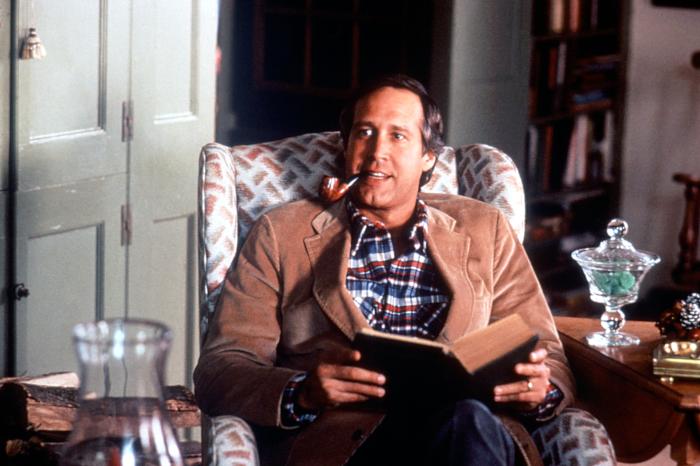
I OWE A DEBT TO CORNELIUS CRANE CHASE. In fact, every guy who has ever over-attempted to be, well, hero-like, owes Mr. Chase for teaching us to not take ourselves too seriously.

If you’ve ever tried to plan an epic family vacation that turned into a disaster; Cornelius taught us to laugh it off.

If you’ve ever attempted to orchestrate a family Christmas that Norman Rockwell would return from the dead to paint, only to have it turn bad faster than an under-cooked turkey; take heart. C.C. Chase showed us that the effort was worth it.

No doubt about it. Cornelius Crane “Chevy” Chase has been an important role model for me and all of us Men Of A Certain Age.

Emily Dickinson wrote nearly 2,000 poems on this desk.Emily's niece described it as Emily's "only writing desk: a table, 18-inches square, with a drawer deep enough to take in her ink bottle, paper and pen. It was placed in the corner by the window …

Emily Dickinson wrote nearly 2,000 poems on this desk.

Emily's niece described it as Emily's "only writing desk: a table, 18-inches square, with a drawer deep enough to take in her ink bottle, paper and pen. It was placed in the corner by the window facing west." 

It’s 7:38 on a Friday night. I’m sitting at a new desk typing this post. The desk was made for us by my Amazing-Missus’ twin brother. It is fashioned from four cast iron legs from an old drill press. It is amazing and so are my Bro-In-Law's welding and creative skills.

I feel, as I’m sitting here at the new desk, listening to Simon and Garfunkel through my Grado Labs headphones, a new burst of creativity. I feel like I could write the next great American novel.

But wait. Images of Chevy Chase in his film “Funny Farm” run through my mind. Don’t tell me you haven’t seen “Funny Farm”!?
Chevy plays a sports writer in NYC. He and his wife move to an idyllic little farm in Redbud, Vermont, where he’s finally going to write that novel he’s been outlining in his head for years.

In true Chevy Chase style, the story turns to hilarious disaster. And I’m reminded to keep things in perspective.

When our oldest son was in pre-school, thirty some years ago, his teacher called his mother aside and whispered, “Do you mind if I ask what your husband does for a living?”

“Why do you ask?”

“Well, today we were sitting in a circle and each child was sharing what their daddy does for a living. When it was Corey’s turn, he started crying and said, ‘Don’t ever ask me that again.’”

It wasn’t that I was a drug-dealer or human trafficker per se. It’s just that he didn’t know how to explain exactly what I did for a living. In fact, I had a hard time explaining it myself. At that time I was what they call a youth ministry consultant. See what I mean?

Also, at that time I was an aspiring writer. I had majored in journalism at the University of Tulsa. I really wanted to be the next J.D. Salinger.

But it’s hard to tell people you’re a writer. It’s one of those jobs that will make your kid cry and say: don’t ever ask me what my daddy does. It’s not like farmer, mechanic, teacher, race car driver, rodeo clown, fireman, you get it.

How do you even know when you’re a writer?

Chuck Sambuchino in Writer’s Digest magazine: “The truth, and you know it down deep, is that it’s not the published book that makes you a writer. You’re a writer because of the things you notice in the world, and the joy you feel stringing the right words together so they sound like music. You’re a writer because you can imagine something in such detail that it comes to life. You’re a writer because you’re obsessed with making your ideas clearer, tighter, fiercer. You’re a writer because you have every reason to stop (it takes too much time, pays too little, and the rejection hurts too terribly), but you can’t do it. It’s not that you love to write so much as you need to write.”

If Chuck is right, I’m going to say it out loud: I’m a writer (at least as an avocation).

After all, I do now have a really cool writing desk. Maybe someday there will be a picture of it on Wikipedia along with an article about some guy known as Pops that wrote a beloved novel called, “That Gone Girl Killed The Mockingbird”.

And then I hear Chevy Chase as “Andy Farmer”, his character in “Funny Farm” say, “As a novelist I turned out to be a pretty good sportswriter.”

What Do You Want?

“I can teach anybody how to get what they want out of life. The problem is that I can't find anybody who can tell me what they want.” —Mark Twain

I’m embarrassed by the number of books on my shelf that share the basic theme of “getting what you want out of life.” You know that ones that start: 5 Easy Steps to This, or 7 Keys to That. And you know what’s even more embarrassing? I’ve read every one of these Be Successful, Be Happy, Be Pretty, Be Blessed, etc. books on that shelf.

I haven’t seen the movie “Gone Girl”; yet. I read the book, and upon completing it, threw it across the room. But I will see the movie. I want to see what director David Fincher does with Gillian Flynn’s screenplay. I’m thinking that the most terrifying thing about this story is there doesn’t seem to be a character in it who has a single worthy aspiration.

Death of a Salesman” is story sort of like that. Poor Willy Loman. I can’t think of a fate worse than having your own son stand over your grave and proclaim of you, “He had all the wrong dreams!”

So, if Mr. Twain could make good on his bold promise,
what would you tell him you want?

I think it is a “big picture” question—you know; not a question like: what do you want to do this weekend, but rather, what do you want them to say about you at your funeral.

As I’ve mentioned before, I’ve been involved in a project called “Storyline”. One of the things I’m learning is that stories (and each of our lives is a story) are either comedies or tragedies. That sounds so reductionist;at first, I refused to accept it. But it’s not as simple as it sounds, even though it’s basically about happy endings and sad endings.

Why would anyone choose a tragic story for their own life? An example: in 30+ years of working with teenagers, many times I saw kids choose a destructive path, sometimes, at least partly, to spite their parents for divorcing and fracturing their family. Not to say that happens every time—it’s just an example.

Many times tragic stories seem to be the only option someone has. Gilda Radner of the original cast of “Saturday Night Live” wrote upon learning of her terminal cancer: “I wanted a perfect ending. Now I’ve learned the hard way, that some stories don’t have a clear beginning, middle and end.”

Back to the abiding words of Mr. Twain, and his scenario of having a mentor or guide who can, not only tell someone how to get what they want out of life, but help them discover what they REALLY want; consider this advice:

Walk right side: safe,
Walk left side: safe,
Walk middle: SQUISH!
—Mr. Miyagi

Not only did Mr. Miyagi show Daniel-san how to win tournament, and get girl; he taught him to aspire to a balanced life. (And to economize speech by eliminating parts of speech like prepositions and articles.)

There are only two lasting bequests we can hope to give our children. One of these is roots, the other, wings. —Goeth

Maybe that’s what I would tell Mark Twain: I want roots and wings. And I want to be known as someone who helped others find their roots and wings. If that’s not too much to ask. Oh, and it would be really useful to learn that rapid hand-rubbing thing Mr. Miyagi does to help aching joints and muscles.


The Interrobang

There is no terror in the bang, only in the anticipation of it. —Alfred Hitchcock

Harper, our middle grand-girl

Harper, our middle grand-girl

Interrogatio is Latin for "a rhetorical question" or "cross-examination";
Bang is printers' slang for the exclamation mark.


Symbols—those little marks that represent something, that tell a bit of a story, that create identity.

For example, if you see a little stylized fish on the back of someone’s car, you assume that they (or the car’s previous owner) professed to be christian. You don’t assume though that the person’s religious convictions extend to more courteous driving or less road rage than their non fish bearing counterparts. And to be fair, we can’t really ask “WWJD” when it comes to driving, because we don’t have any record that Jesus ever drove anything (except the occasional evil spirit—from a person to a pig).

I like symbols. I think they’re interesting. I’ve yet to find a symbol however, that I was so affiliated with that I would have it tattooed on my person, but I have held allegiance to a few symbols over the years, enough at least to wear them as jewelry.

The Peace Sign was one. (Or, as it was called by “rednecks” back in the day: “the footprint of the American chicken.”)

For me, the symbol probably had something to do with my adolescent need to “belong.” It was like the brand of the 60s counter-culture movement and a tribe that was very accepting. Maybe I wore it out of wishful thinking—hoping that somehow if we rallied around the dream of peace I might not get drafted and end up in a jungle in Southeast Asia fighting in a war I didn’t understand.

When that war finally ended, I put the peace sign in a box with my “McGovern for President” button, and my idealism. I still have that box and occasionally drag it out and remember the old days “better than they were.”

Today, if I were to wear a symbol or give serious consideration to symbol-style tattoo, it would be an interrobang. The interrobang has an interesting history. You should Google (v.) it. The interrobang is a punctuation mark that actually appeared on Remington typewriters briefly. It really never made it’s mark though. (Although it is still included in many fonts on your computer.) It was a combination of a question mark and an exclamation point.

As I hinted at the beginning of the post the interrobang would be used at the end of a hypothetical question, being asked with a sort of gusto, like: “Wow, did you see that?!” or “What the what?!” You get the idea, right?!

Just as the peace sign was a good symbol for me in my first coming-of-age, the interrobang serves me well now, in my second.

There was once a day of youthful confidence; swagger, if you will. Today it seems like everything I used to feel certain of, in an exclamatory kind of way, also has a certain question to it. For example, say we’re trekking across country, my Amazing-Missus might ask, “Do you have any idea where we are?” And I reply, “Of course I do! I think?” Or the doctor asks, “How are you doing?” “Great!” I exclaim. “Aren’t I?”

That picture at the beginning of this post, of our middle grand-girl, Harper; her dad took that and commented about her “eye of the tiger” look. She will be 3-years old Saturday. I hope she always keeps her eye-of-the-tiger, strength-of-her-convictions swagger. Some will see it and call it "strong-willed". Her Pops will see it and will remember a day when he had it. A day when he thought Peace was attainable. A day when he was less squishy about his certainties.