NOSTALGIA

THAT'S A BIG WORD. It needs to be because it carries a lot. Here's sort of a concensus defintion from a few dictionaries:

A yearning to return to an earlier time remembered as happier or more pleasant, or a former place evoking happy memories; a longing to experience again a former happy time.

See what I mean?!

I'm fully aware of the biblical warning about too much sentimentality:

Don’t long for ‘the good old days.’ This is not wise.
— Ecclesiastes 7:10 NLT

More than likely I'm misunderstanding the theology here, but a little looking back seems innocent enough and even wholesome (as long as we don't get stuck back there in some kind of "Back To The Future" time warp.) I'm not trying to read the mind of the writer of Ecclesiastes or diminish his wisdom, but he was pretty deep in his "Life is meaningless" phase in chapter 7. I've always been pretty good at finding a way to justify straddling the lines of biblical mandates while staying within the guardrails of protestant guilt. [Is it metaphor mixing if your examples are on the same road, the one with a strong center line and high guardrails? We can burn that bridge if we come to it.]

It looks to me like there's one more loophole in the reminiscing rule: maybe it's okay to journey back to the good old days; we just shouldn't "long" for them. It's sort of like that shadowy line between temptation and lust. Lust is a sin; temptation is not. Remember the truth is that Jesus was tempted in ALL ways as we are yet without sin. Still there is that definition of nostalgia which includes words like longing and yearning. Let's call what we're doing nostalgia-lite. We're just visiting the back-in-the-day for awhile, resting in the innocence and the beauty of simplicity. We'll return to the present after the holidays when we make our forward-looking resolutions for 2026. We should probably drop some gingerbread crumbs on our sentimental journey so we can find our way back though.

Now that I've established that we can do some harmless, seasonal reminiscing let's get started. This time of the year is just bursting with opportunities for nostalgia. All the triggers are here: the sights and sounds and smells, the music, the twinkling lights, wreaths and bells and trees; peppermint and pine. When it comes down to it, isn't that what the season is about: remembering and celebrating? Senior adulthood requires that I watch and read the news and acknowledge the reality that many, too many, in our world have little to celebrate. The harshness of the world in front of them is bound to obscure the promise of hope and peace. Nostalgia for many is bittersweet at best.

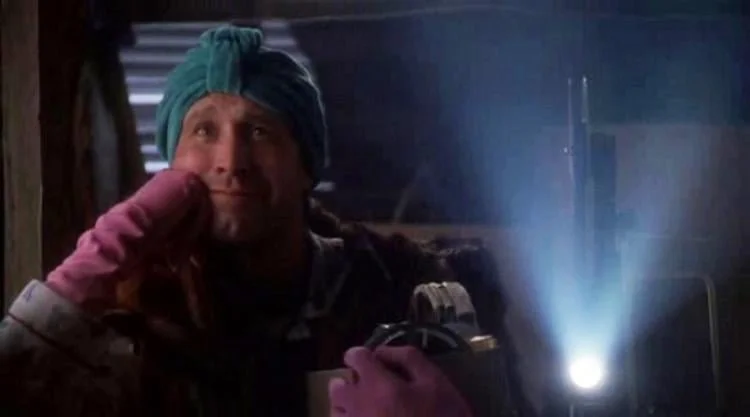
Admittedly, nostalgia for me these days is a way of escape. Without getting too bleak, I find the debasing of civility, the dehumanizing rhetoric of politics and the blurring of what is really good and true and beautiful to be disheartening. So, reverie is like layering on warm quilts, turning on a good movie like "Love Actually" or "While You Were Sleeping"; blocking out the uglier ooze. Another tactic for me is to try to provide an alternative to all that while creating the fodder of future nostaligia for the kids and grandkids--sort of like that hapless hero of happy family memories creation: Clark Griswold. In the classic story of Clark and his high hopes for the ultimate Christmas, "Christmas Vacation", we get to see the perfect portrayal of nostalgia: Clark sitting in the attic, wrapped in discarded clothes, watching old home movies of Christmases past and remembering them "better than they were." And in the background we hear the song...

Christmas is the time of year
For being with the ones we love
Sharing so much joy and cheer
What a wonderful feelin'
Watching the ones we love
Having so much fun

I was sittin' by the fire side
Taking a walk through the snow
Listening to a children's choir
Singing songs about Jesus
The blessed way that he came to us

Why can't it remain
All through the year
Each day the same
That's what I wanna hear
It's truly amazin'
That spirit of Christmas

All the kinfolk gather 'round
The lovely Christmas tree
Hearts are glowing full of joy
Sense the gifts that we're giving
And the love that we're living

Why can't it remain (Why can't it remain?)
Oh, all through the year (All through the year)
Each day the same (Each day the same)
Ah, that's what I wanna hear
Listen to me, it's truly amazin'
That spirit of Christmas

Every year our boys would decorate gingerbread houses their mom made for them. And, for seventeen years and counting she has made them for our grandkids and hundreds of other peoples kids and grandkids.

This year for Christmas I decided I wanted to relive the moment of one of my favorite Christmastime memories--the year I got a real Lionel train set. In true Griswoldian style I've created a little Christmas village for my new train. In a few days the grandkids will make their houses and they will become the homes that the train encircles, all done in the spirit of treasurable moments.

Quickly, these moments will pass and I'll ask, as the song does, "Why can't it remain all through the year, that spirit of Christmas?"


RELEGATION

The cheap seats, back of the line, general admission, the bench, boarding group C, looking in from the outside... Sometimes we might feel like we have been relegated to something "less than". But hold on to your dinner roll a minute.

Tis the season; a trip in the grocery store and the first displays to greet you are the boxes of Stove Top, the cans of yams and bags of marshmallows, cranberry sauce and of course the trifecta of key ingredients for the green bean casserole. Besides the turkey these are the key fixin's on every Thanksgiving table--or should we say "tables"--plural. Just as the pilgrims before us, at any family gathering there will be the lowly Kid's Table. And, by lowly, I mean literally, physically lower than the big table; and also low enough to create a sense of longing to see the day when we can move up. But maybe the Kid's Table has gotten a bad rap and/or rep. Maybe it's not the place of relegation it appears to be. Maybe it's not a bad place to be.

Look at it: there's little chance of walking away from the kid's table stuffed. You've probably only had to eat "just one bite" of something. The only thing you're eating for sure is the big dollop of Cool Whip from the top of your pumpkin pie, or if you're lucky (as our grandkids are), you'll have a spray can of something akin to whipping cream which you can shake vigarously and squirt directly into your mouth.

As for discussion, the Kid's Table talk is free of politics and religion. The most heated conversation I've heard lately at a Kid's Table was the one between our two grandboys ages 8 and 5: Is fishing a sport or not? The 8 year-old who loves fishing is firmly on the side of definitely a sport. The 5 year-old, who had a successful T-ball season says "No Way!" He also doesn't feel that cheerleading is a sport. Luckily his older sister the cheerleader wasn't at the table.

This week, on November 17, our oldest Grand turned 17, her "golden" birthday (the calendar day of her birthday matches her age). I asked her about being the oldest at the Kid's Table. "When does one promote to the Big Table?" She said "Maybe 18?" with a hint of innocence lost in her voice. So this year will be her last at the Kid's Table. The little ones will miss her. The grown-ups will still be the grown-ups.

As kids, my brother and I, along with our parents, would make the pilgramage to a little town in Louisiana where our Dad was born and raised. Our grandparents, aunts, uncles and cousins were there, as was the Kid's Table. We knew our place. We were reminded of what that meant on the long roadtrip "over the river and through the woods". "Eat a bite of butter beans and try the duck. Remember to say yes sir and yes ma'am. Asked to be excused from the table when you're through eating."

It seems like in the deep south, knowing and staying in one's place was a sign of respect--respect for tradition and acknowledging social and familial status. It was also expected. And, in the 50s and 60s, those expectations could have an air of relegation to them.

Remembering the One from whom all blessings flow, with a counting of some of those blessings, a deep breath or two of fresh air and grace, all of the tables become important, they all become the same height, they are all in the same room, the same significance and fraught with the potential to listen and learn and love.

Maybe there's something we can discover from the Kid's Table. Are there grateful little hearts at that table? YES! Sometimes gratitude is most evident in joy. Watch the joy and fun radiating from that little table. Maybe when Jesus talked about being like the children he was pointing to the Kid's Table. Maybe if Jesus were to come to our house for Thanksgiving He would sit at the Kid's Table. Maybe I should too.

GOOD AND A GOOD STORY

"Let's watch 'Garfield'."

"No, 'Sonic'!"

"I want 'Lyle, Lyle Crocodile'."

"We watched that last time."

We had three of the Grands spending the night with us. We had just finished the buffet that Mimi fixes because there is no concensus among: quesadillas, scrambled eggs, corn dogs, sloppy joes, and spaghetti. The last word of one of the parents after delivering 2/7 of our bundle of joy: "They've probably had enough sugar already today."

So after lemonade and ice cream sandwiches, it's movie time.

Cutting off a filibuster by the five-year-old, I offer the solution. "Let's watch 'Karate Kid'." The aforementioned 5YO tells us he knows karate and starts his demonstration on his brother, his cousin and his Pops.

"Is this a good choice?" My Amazing Missus asks, but means, "This is not a good choice."

"Is it appropriate for kids 5, 8, and 10?" she asks.

I explain that it is rated PG-13, which in my interpretation stands for "Pops' Guidance" and I can give 13 reasons why this will be fine, and besides they're going home tomorrow and their parents can debrief them.

It proved to be an excellent discussion starter--not about the key issues of things like: intergenerational friendships, balance, focus, looking deep enough to see the morsels of beauty in life, being able to catch a fly with chopsticks, but still...

The questions were more like: why is his mom making him move from his home? Where is his dad? What is a bully? Isn't that a bad word? Then why does he keep saying it? Can we switch back to "Lyle, Lyle Crocodile?" Can I have another ice cream sandwich? Why is Mr. Miyagi making him do all that work?

"Just wait and you'll see!" I tell them, giddy for the moment that Mr. Miyagi reveals his subterfuge and demonstrates that by building muscle memory with stuff like wax-on; wax-off, sand-the-floor and paint-the-fence, he has in fact taught him karate. I look at them carefully in that moment to watch their eyes when the eureka lightbulb comes on for them. NOTHING. No "aha". The connection fails. Maybe later at the finals of the "18 and Under All-Valley Tournament."

We all cheer for and celebrate Daniel's win; for various reasons.

As Mr. Miyagi beams with pride for his young student, as the dark husks of Cobra Kai slink back to their dojo. As Daniel San hoists the trophy and finds balance with Ally, his tormentors and himself, I wipe a tear from my eye. The Grands don't notice. They're too busy practicing the "Crane Technique" on one another.

Reflecting on this movie that I've seen too many times, I can't help but draw comparisons between the “No Mercy, Sir” essence of the Cobra Kai dojo and the meaner side of The Whitehouse. I can't cleanse from my psyche the image of J.D. Vance in a karate costume with that smirky grin, along with Musk and his chainsaw, yelling "Sweep the leg Donnie!" in a trumped-up fight with PBS, NPR, The Kennedy Center, public education, higher education, The National Endowment for the Arts, The National Endowment for the Humanities, and all things that can enrich and inspire, which we've apparently taken for granted. This fight, it seems to me, isn’t so much between left and right, or good and evil. It’s about illumination vs. darkness.

The youngest of our group won the battle for the next feature of movie night: Lyle, Lyle, Crocodile. Turns out there are lessons to be learned here too. Consider Mr. Grumps who hides his manipulative ways behind the persona of being a good neighbor. It's a cautionary tale to be wary of those whose ruse is "keeping things right" or making something nebulous great again. Watch out Mr. Grumps, we see you for who you are. Even your cat has turned against you.

I have a friend, Alissa Wilkinson, who is a movie critic at The New York Times. She has a new book out called, We Tell Ourselves Stories: Joan Didion and the American Dream Machine.

In an interview with Sojourner magazine about her book featuring the writer Joan Didion, Alissa is asked:

You write, “We seek meaning and order in the world by creating story arcs that tell us why things happen and how they will sort themselves out.” What is one of the prevailing stories you continue to tell yourself today?


So here’s the thing: You don’t know that you’re telling yourself that story. That’s kind of the point that she (Didion) makes throughout her work, starting from when she is writing The White Album where she writes the line, “We tell ourselves stories in order to live.” But she was saying this much earlier than that, just not crystallized yet.

Everyone tells themselves stories, whether it’s stories like “this person deserves to experience this political repercussion because they are bad in this particular way,” or simple ones that the movies are always telling us like “good things happen to good people” and “follow your heart” and “don’t let anyone tell you who you are, be yourself.” Those are stories that we make up. They’re longer in story form, but those stories tell us how to live.

I think for Didion, the thing that you had to do if you were a person of any moral seriousness was to try to see the story and continually try to figure out where it came from and whether it is the right story or whether it needs modification.


I love stories and seeing the stories we live. But, I realize we have to be careful. To Alissa's point, if we hear a story, for example, about a young leader in Ukraine being an aggressor, subjecting his country to death and destruction, we are hearing a false narrative. It's told for truth and it's told again and again and again until it sounds plausible. We need "to see the story and continually try to figure out where it came from and whether it is the right story or whether it needs modification."

Objectivity is not a strength for me. For some reason I cannot see black and white exclusively and distinctly. Like the days of TV when I grew up, when our TVs were called black and white but in reality they were shades of gray. Now I still see those shades; and colors too. I hope that each story will end with: "and they lived happily ever after." But I'm older now and more calloused, and jaded, and starting to think not all stories end as I had hoped. But, still...

BONSAI DANIEL SAN. BONSAI!


Why does Mr. Miyagi yell Bonsai to Daniel?

Mr. Miyagi yells “bonsai” to express his enthusiasm and appreciation for tasks done exceptionally well. The phrase implies that the task has been completed with precision and care, much like a bonsai tree is sculpted into perfection over time. He also uses the phrase as a motivator, encouraging those around him to strive for excellence in their craft. Beyond this, he likely uses it as an expression of pride at having passed down his wisdom and skills to others who can now use them to find success. --bonsaitreehelp.org.

MY GOOD FRIEND DOUG

If you have had a conversation of length with me since the early 70s, you have probably heard me say something like:

- My good friend Doug says...

- My good friend Doug tells this story about...

- My good friend Doug wrote in one of his books...

Doug Manning was our pastor when we were newlyweds. And, he has been our "pastor" until his passing on January 27, 2025. The fact is though that he will continue to be our pastor as long as we both shall live--and maybe beyond. Our kids and grandkids have heard so many Doug stories; they're like an ingredient baked in to who we are.

I'm using the word "pastor" here in the sense of a shepherd, a guide, a spiritual mentor. I have been so fortunate to have had a few of that type in my life. The first was my father. Dad and Doug were both pastoring churches in Tulsa when they became friends. Doug spoke at Dad's memorial service. I remember the entire sermon: "We don't need a sermon today. If you are here then you knew Bill Fuller. And, if you knew Bill then you knew his life was the sermon." And he sat down.

There have been two times that Doug was also our pastor in a church leader role: in the 70s at Southern Hills Baptist Church in Tulsa, and then in the early 20-teens we started a church together in Oklahoma City. Doug wanted to call it "The Church of the Pissed-Off Baptists", but we figured we wouldn't be able to find a building large enough, so we went with Kindling Community. It was a wonderful, eclectic group with wildly and widely diverse faith views and worldviews, all focused on the exploring of ways to be followers of Jesus in the 21st century. It was amazing, and endured until Doug's eyesight made it nearly impossible for him to read and prepare.

It was the pastoring in between the church gigs that have come to mean the most to me. My Amazing-Missus and I met with Doug almost every Friday night for many years for dinner and to spend the evening discussing life. No subject was off limits.

When Covid forced all indoors, we started a group that met once a week through Zoom, the online meeting utility. I have long been fascinated by a group called The Inklings. They met regularly in a pub in Oxford, England. The members included J.R.R. Tolkien and C.S. Lewis. We decided we would fashion our Covid-era Zoom meeting after The Inklings. We called it the Quarantine Tavern and although the pandemic has subsided we still meet nearly every Sunday night. Doug has missed the last few meetings. The cancer that had come on him with vengeance caused him pain and fatigue.

My last communication with him was a text he sent to me Sunday afternoon, January 26, just hours before he passed. In the text he told me the doctors had no good news for him and he ended with these words: "the cancer is back and it’s very very very, very growing very fast so Tuesday I have another CAT scan and Wednesday I have an appointment with him and then he made me go ahead and get an appointment with my another appointment with my radiologist so I don’t know where we are, but he did end up by saying I don’t think I can give you a good outlook or a good answer so that’s where I am. I’m not in as much pain. I’m happy I’m relaxed and I’m not bored a whole lot about anything, but I thought maybe the group should know where things are. Hope y’all have a good meeting tonight."

So this guy who has authored more than 50 books, traveled the world speaking on the issues of death and grief, is taking the time to tell a group of friends the truth and then wishing us well on a meeting he won't be able to attend.

I could go on and on and on, so I decided to boil it down to a Letterman-style Top 10.

Things I learned from Doug:

#10. Pay close attention.

#9. Listen carefully and deeply.

#8. When it comes to regrets, learn the lesson and move on.

#7. Hurt people hurt people.

#6. Barbara Streisand was right: "People who need people are the luckiest people in the world."

#5. Keep your cussing current.

#4. You can't behave your way into a relationship with God. You just have to believe and deeply hold on to the fact that He loves you and see what that does for your behavior.

#3. There's more good theology in "The Velveteen Rabbit" than is delivered in many pulpits on any given Sunday.

#2. Be wary of those who only quote scripture from the Old Testament and Paul's letters.

#1. Don't forget to write.

Let me say this about that last one. It is a line from the movie "Finding Forrester". It's about an older man and a younger one. They both want the best for each other. Their common ground is writing. Doug and I shared a love for writing. In the movie, the older man is going off on a trip and the younger one tells him, "Don't forget to write” - using the old line offered so many times in a farewell, but with the twist of holding one another accountable to write, to create, to strive to be a better version of ourselves. Often we would say goodbye, one of us would say, "Don't forget to write."

That is who Doug was to me. How can you not love someone who you know cares for you unconditionally? How can you not be broken hearted at their passing? It's selfish I know. But it's real. I hurt for his amazing family. They have generously shared Doug with me, My Amazing-Missus, and all the others he touched so deeply.

Doug was the last of a generation for me. It makes me miss my father even more. Now I'm the old guy for sure. I have no one left who is older that I can call on. But I do have the treasure of having had those people in my life. That's enough for now.

Old men ought to be explorers
Here and there does not matter
We must be still and still moving
Into another intensity
For another union, a deeper communion
--T.S. Eliot