Beautifuller

The band (a small group of very talented, humble musicians) was playing, the stained glass windows colored the light as it came through; it all had a beauty to it. To make it beautifuller I was sitting next to Karlee, at 5 years-old, our oldest grand-girl.

The words to the song the band was singing were projected on a screen at the front of the church. One of those words was “beautiful”. Karlee pointed out to her Mimi that she knew that word. Then she took an offering envelope and a little pencil from the pew rack and wrote the word to prove it.

She wrote the word again and then added an “ler” to the end of it. She explained to me, “See, Pops, normally you would say, ‘more beautiful’ but I wrote ‘beautiful-ler’, so it has my last name ‘Fuller’ in it.”

She went on to add a little cloud and rainbow as if to give us a visual reference for “beautifuller”.

From the 5 year-old hand of Karlee Fuller

From the 5 year-old hand of Karlee Fuller

Now I won’t insult your intelligence by trying to convince you that this post is largely about anything but an opportunity to brag about my granddaughter, but there is more to it. Indulge me.

The thing about kids is that they see more beautifuller than we do. There is still a wonder and curiosity stirring in them that causes them to be fully alert, asking, “Why, Pops; Why?”

Take the beauty of the colors that nature is offering us right now. I’ve seen autumn sixty-four times now—I get it. The theme song of the bored and cynical should be: “Been There, Done That”.

I have a certificate in a box of treasures my mom gave me that says I was enrolled in the “Cradle Roll” of the Brookside Baptist Church of Tulsa, Oklahoma, when I was just weeks old. Last Sunday morning I sat in what could have been church service number ten-thousand-plus for me. (64 years times 52 weeks times three, for two service on Sundays and one on Wednesday, not counting revivals, camps and vacation Bible school.) I’m not complaining, bragging or expecting a medal of some kind; I’m just saying…

Some times it takes a 5 year-old, to say, “Look Pops! It’s Beautifuller.” And when I do look—she’s right!

I just finished a wonderful book by Wendell Berry, “Jayber Crow”. I highly recommend it. Maybe you won’t read it but at least read this excerpt. This is written in Jayber’s voice. He is the bachelor barber and church janitor in a small town in Kentucky: 

     In general, I weathered even the worst sermons pretty well. They had the great virtue of causing my mind to wander. Some of the best things I have ever thought of I have thought of during bad sermons. Or I would look out the windows. In winter, when the windows were closed, the church seemed to admit the light strictly on its own terms, as if uneasy about the frank sunshine of this benighted world. In summer, when the sashes were raised, I watched with a great, eager pleasure the town and the fields beyond, the clouds, the trees, the movements of the air—but then the sermons would seem more improbable. I have always loved a window, especially an open one.
     What I liked least about the service itself was the prayers; what I liked far better was the singing. Not all of the hymns could move me. I never liked “Onward Christian Soldiers” or “The Battle Hymn of the Republic.” Jesus’ military career has never compelled my belief. I liked the sound of the people singing together, whatever they sang, but some of the hymns reached inside me, all the way to the bone: “Come, Thou Fount of Every Blessing,” “Rock of Ages,” “Amazing Grace,” “O God, Our Help in Ages Past.” I loved the different voices all singing one song.
     I thought that some of the hymns bespoke the true religion of the place. The people didn’t really want to be saints of self-deprivation and hatred of the world. They knew that the world would sooner or later deprive them of all it had given them, but still they liked it. What they came together for was to acknowledge, just by coming, their losses and failures and sorrows, their need for comfort, their faith always needing to be greater, their wish (in spite of all words and acts to the contrary) to love one another and forgive and be forgiven, their need for one another’s help and company and divine gifts, their hope (and experience) of love surpassing death, their gratitude. I loved hearing them sing “The Unclouded Day” and “Sweet By and By”.
     And in times of sorrow when they sang “Abide with Me,” I could not raise my head.

Thank you Karlee. You have made your old Pops see beautifuller.

"The pursuit of truth and beauty is a sphere of activity in which we are permitted to remain children all our lives."  —Albert Einstein

It Has A Face

"How can they meet us face to face till we have faces?” 
― C.S. Lewis, Till We Have Faces

Normally I wouldn’t be overly attentive to news of an uprising in Burkina Faso. And, while I shouldn’t admit it, the concern about the spread of ebola wouldn’t have mattered much until it reached as close as Dallas; that is until I realized that Burkina Faso is near the heart of the outbreak in Liberia, Guinea, and Sierra Leone.

That’s the way it is, you know?  We don’t care a whole lot about anything until it has a face. For example, we understand the horrors of cancer once it has a face. By that, I mean, someone we personally know gets THE diagnosis. For me the first time cancer really had a face was my mother-in-law, Betty. It took her life at 49.

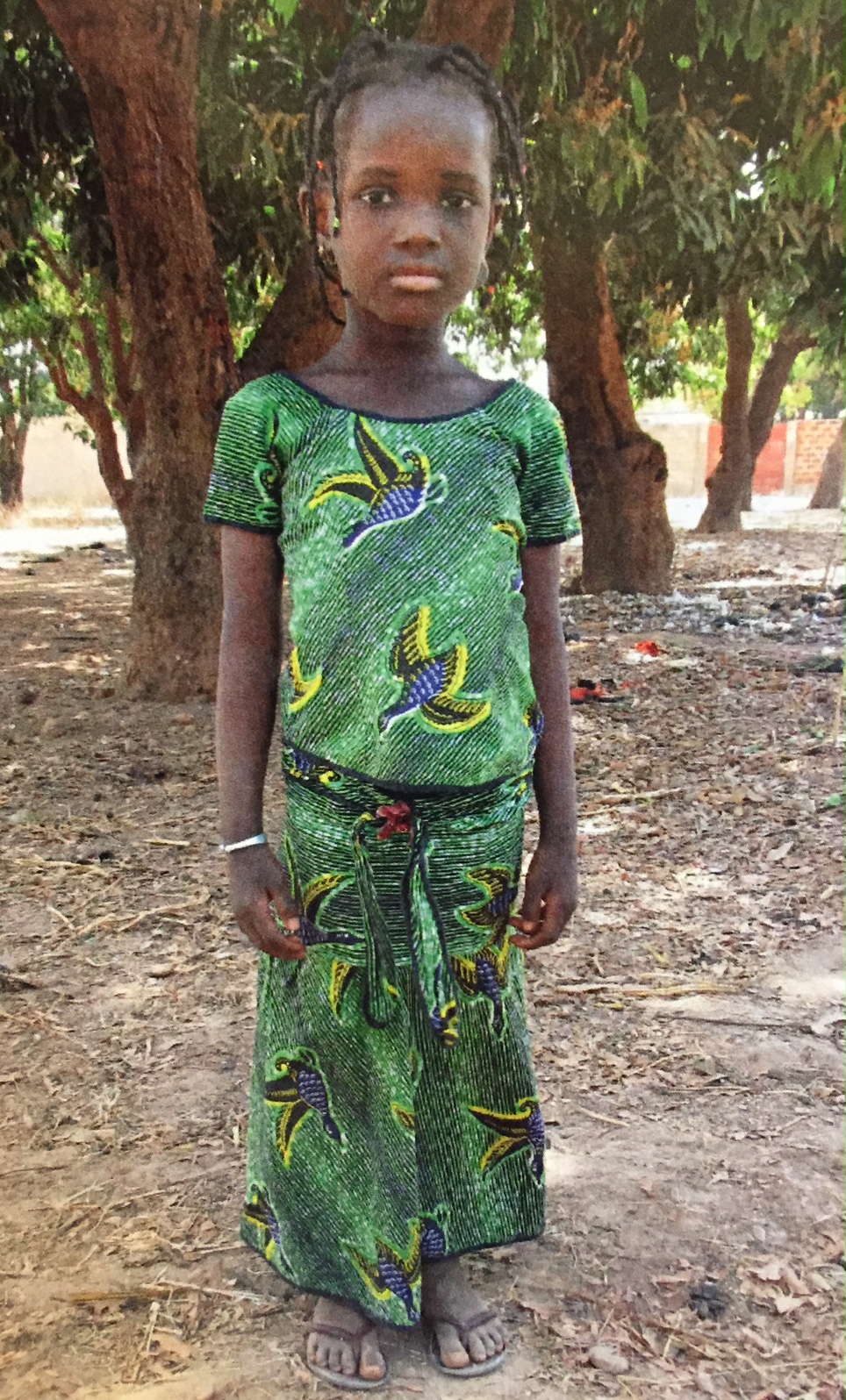
Why am I concerned about disease and political uprising in Burkina Faso? Because it has a face for me now. For several years, I have “supported” a little girl there. We send a little money to her each month and on special occasions through a wonderful organization called “Compassion” www.compassion.com.

Maimouna

Maimouna

She is a beautiful little girl named Maimouna. She is just a bit older than our oldest grandchild Karlee. In her last letter to me she drew pictures of her favorite things: her friend, a doll and a ball. Just a few days ago I put a letter in the mail to her. It included a picture that Karlee drew for her. I hope she gets it. The parliament building of her town is burning to the ground; today.

Several years ago I became involved with a group called the International Arts Movement based in New York City, and had the privilege of serving on their board of directors. The movement was founded by an artist named Mako Fujimura. Mako and IAM helped me with a language for a dilemma in our culture that was troubling to me. Mako had an epiphany of sorts following the events of 9/11, which impacted his community in NYC directly. He made a plea for artists and other culture-shapers to “re-humanize” the world. One way to look at what that means is for us to really see real faces.

For me, for today, when I heard Burkina Faso in the news, I immediately saw the face of my little friend Maimouna. My heart breaks for her and her family and the on-going de-humanization that comes with disease, and strife, and so; in Burkina Faso and in Oklahoma City.

“No man can be an exile if he remembers that all the world is one city.” 
― C.S. Lewis, Till We Have Faces

A Life, A Rhapsody

I’m not the first to draw an analogy between a life lived and a composition. One of my favorite examples is from “Mr. Holland’s Opus”, a movie I wrote about here. Mr Holland was the band director of a high school for many years. In a scene toward the end of the movie, one of his former students, Gertrude Lang is speaking at an assembly given to honor him:

“There is not a life in this room that you have not touched, and each of us is a better person because of you. We are your symphony Mr. Holland. We are the melodies and the notes of your opus. We are the music of your life.”

What a wonderful tribute. What a beautiful metaphor for a life’s story.

In 1924, George Gershwin composed “Rhapsody In Blue.” It is a classic. It was the hallmark of music scored for orchestra written in jazz forms of the 20s. A rhapsody, and particularly “Rhapsody In Blue”, is characterized by its range of emotion and tonal qualities along with a feeling of improvisation, but with a recurring theme.

A rhapsody is literally an epic poem, written in one movement, recited or played from start to finish. 

I want to tell you of a story of a boy. To me this boy’s life is a rhapsody.

This boy grew up in Lincoln Parish, north central Louisiana, in a little town called Dubach (dew-bach). It was clear to all that love and loyalty for family would be a theme of his life.

I didn’t know him as a boy, but I know from the stories I’ve heard that he made the most of every life experience and relationship. His stories are rich and humble. In fact there is a humility that everyone who knows him, knows is genuine.

There are some things I know for sure about him. He loves music. He was a musician himself. He played the clarinet. I think it’s interesting that “Rhapsody In Blue” starts with a clarinet solo, just as the rhapsody of his life does. He is a great encourager of the musical pursuits of others.

He has never been one to be the center of attention. In fact, he is one of the most selfless people I’ve ever known—always doing what he could to allow others to have their moment in the light.
He reluctantly tells stories of his service in World War II; if you ask.

Just as “Rhapsody In Blue” debuted in 1924, 90 years ago; so did this man. Happy 90th Birthday Dad!

My Dad has provided wonderful guidance and instruction for me all of my life. Some of it has taken, unfortunately some I have squandered. 

Dad never told me I should pray and read my Bible. I came to understand how valuable those things are by watching him practice those disciplines himself. If I am a good husband and a good father and a good grandfather, it is because of the example he has provided.

My Dad understands that the highest calling in life is one of service. It is another of his life’s themes. He has given so much and sacrificed so much—he and my mom both. I look back now on my first drum set and I know that they sacrificed much for me to have those. I know that for my Dad, as a Baptist preacher, to have a son playing drums in a rock and roll band, back in the day when Baptists were particularly concerned about rock music and dancing, must have been difficult. Yet somehow he managed the conflict because he wanted me to love music.

Over the last few years, I’ve watched Dad age with the same grace by which he’s always lived. His eyesight is nearly gone. One day I said something about how hard that must be, yet I never him complain. His reply was, “You know in some ways I see more now than I ever have.”

Here’s the thing about him and those beautiful attitudes of his: “Rhapsody In Blue” is a masterpiece, but only when it is played by master musicians under the direction of a master conductor. Many years ago when my Dad yielded his life to God as an instrument in the Master’s hands, it took. I swear, it’s as if it was his destiny. Thank you Dad for being faithful.

Oh, and those words of Gertrude Lang to Mr. Holland:

“There is not a life in this room that you have not touched, and each of us is a better person because of you. We are your symphony Mr. Holland. We are the melodies and the notes of your opus. We are the music of your life.”

I am honored to be a part of Mr. Fuller's Rhapsody.

In My Own Words At My New Desk

I OWE A DEBT TO CORNELIUS CRANE CHASE. In fact, every guy who has ever over-attempted to be, well, hero-like, owes Mr. Chase for teaching us to not take ourselves too seriously.

If you’ve ever tried to plan an epic family vacation that turned into a disaster; Cornelius taught us to laugh it off.

If you’ve ever attempted to orchestrate a family Christmas that Norman Rockwell would return from the dead to paint, only to have it turn bad faster than an under-cooked turkey; take heart. C.C. Chase showed us that the effort was worth it.

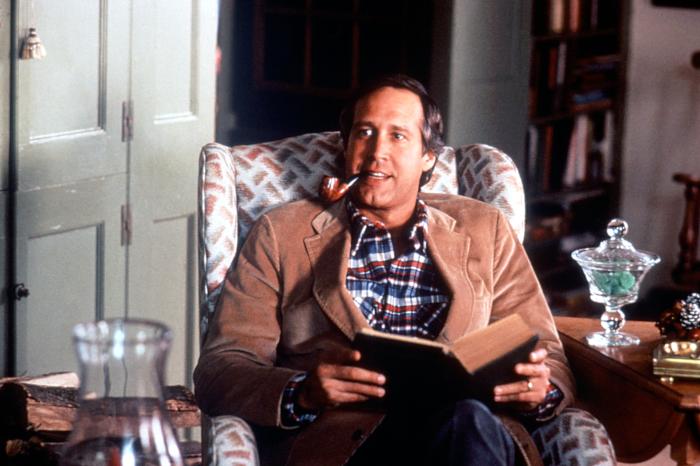
No doubt about it. Cornelius Crane “Chevy” Chase has been an important role model for me and all of us Men Of A Certain Age.

Emily Dickinson wrote nearly 2,000 poems on this desk.Emily's niece described it as Emily's "only writing desk: a table, 18-inches square, with a drawer deep enough to take in her ink bottle, paper and pen. It was placed in the corner by the window …

Emily Dickinson wrote nearly 2,000 poems on this desk.

Emily's niece described it as Emily's "only writing desk: a table, 18-inches square, with a drawer deep enough to take in her ink bottle, paper and pen. It was placed in the corner by the window facing west." 

It’s 7:38 on a Friday night. I’m sitting at a new desk typing this post. The desk was made for us by my Amazing-Missus’ twin brother. It is fashioned from four cast iron legs from an old drill press. It is amazing and so are my Bro-In-Law's welding and creative skills.

I feel, as I’m sitting here at the new desk, listening to Simon and Garfunkel through my Grado Labs headphones, a new burst of creativity. I feel like I could write the next great American novel.

But wait. Images of Chevy Chase in his film “Funny Farm” run through my mind. Don’t tell me you haven’t seen “Funny Farm”!?
Chevy plays a sports writer in NYC. He and his wife move to an idyllic little farm in Redbud, Vermont, where he’s finally going to write that novel he’s been outlining in his head for years.

In true Chevy Chase style, the story turns to hilarious disaster. And I’m reminded to keep things in perspective.

When our oldest son was in pre-school, thirty some years ago, his teacher called his mother aside and whispered, “Do you mind if I ask what your husband does for a living?”

“Why do you ask?”

“Well, today we were sitting in a circle and each child was sharing what their daddy does for a living. When it was Corey’s turn, he started crying and said, ‘Don’t ever ask me that again.’”

It wasn’t that I was a drug-dealer or human trafficker per se. It’s just that he didn’t know how to explain exactly what I did for a living. In fact, I had a hard time explaining it myself. At that time I was what they call a youth ministry consultant. See what I mean?

Also, at that time I was an aspiring writer. I had majored in journalism at the University of Tulsa. I really wanted to be the next J.D. Salinger.

But it’s hard to tell people you’re a writer. It’s one of those jobs that will make your kid cry and say: don’t ever ask me what my daddy does. It’s not like farmer, mechanic, teacher, race car driver, rodeo clown, fireman, you get it.

How do you even know when you’re a writer?

Chuck Sambuchino in Writer’s Digest magazine: “The truth, and you know it down deep, is that it’s not the published book that makes you a writer. You’re a writer because of the things you notice in the world, and the joy you feel stringing the right words together so they sound like music. You’re a writer because you can imagine something in such detail that it comes to life. You’re a writer because you’re obsessed with making your ideas clearer, tighter, fiercer. You’re a writer because you have every reason to stop (it takes too much time, pays too little, and the rejection hurts too terribly), but you can’t do it. It’s not that you love to write so much as you need to write.”

If Chuck is right, I’m going to say it out loud: I’m a writer (at least as an avocation).

After all, I do now have a really cool writing desk. Maybe someday there will be a picture of it on Wikipedia along with an article about some guy known as Pops that wrote a beloved novel called, “That Gone Girl Killed The Mockingbird”.

And then I hear Chevy Chase as “Andy Farmer”, his character in “Funny Farm” say, “As a novelist I turned out to be a pretty good sportswriter.”