
FOR MICHAEL

I just don’t understand. It’s happened again. A friend has passed, too soon, too painfully, too tragically. This one is particularly hard because we need all the good guys we have. We need the musicians, the problem-solvers, the-givers-of-unconditional-love. We need the great husbands, fathers, grandfathers, and friends, we need the eternal optimists and people of unrelenting courage and faith. We need Michael.

D1FBC98B-A043-4469-A6A1-5ED76BD98100.jpeg

No one knows this better than his family and those who worked with him: he could always be counted on to solve, to encourage, to see a better path forward; always forward.

Remember that “Mikey” from the LIFE cereal ad? No one wanted to risk dipping their spoon into that bowl of the unknown and untried. “Let Mikey try it. He’ll try anything!”

Our Mikey was like that. Whether it was trying to help someone start their car or facing a multi-million dollar deal at the office… Let Mikey try it. And he would.

But. What do we do now? If he were still here we would turn there for his sensible, reliable, sound and wise guidance.

I first met him when he was in high school. We had just moved from Tulsa to El Reno where I would be the youth minister of one of the churches in town. I kept hearing about this guy named Michael and I knew that I wanted to recruit him to our team, but alas he was a faithful and committed member at his own small church. It was early though when I figured out that this guy’s life was unique. I’m going to compare it to a musical, literally and metaphorically. Remember the movie “Mr. Holland’s Opus” about a dedicated high school band director who realized only late that his life’s story was an opus—a cumulative work, a musical composition?

If Mr. Holland’s life’s work was an opus, Micheal’s was a Broadway musical. Not because it was overly grand, but because it was so real, so relatable and loved by so many. He literally sang about everything in every scenario. Even before his first drink of coffee in the morning he was singing about having his first cup of “caffeine soup”.

So, if my comparison holds true, what would you call the last eight or so months of his life: the final verse? A last chorus?

NO. I don’t think so at all. I’m going to call it a bridge. If you’re not familiar with the bridge in musical composition—well check out this explanation:


What Is a Bridge In a Song?

A bridge is a section of a song that’s intended to provide contrast to the rest of the composition. From The Beatles to Coldplay to Iron Maiden, songwriters use bridges to change moods and keep audiences on their toes. Typically, a bridge will follow a chorus section and present something different—whether it’s a different chord progression, a new key, a faster or slower tempo, or a meter change. A song doesn’t end on its bridge, so there will always be an opportunity to steer the composition back to its main themes once the bridge has concluded. —from Masterclass


And there it is. At first, it appears as a different song, which would mean the first one ended, but it’s not that. It’s something different: a new key, a tempo or meter change.

“A song doesn’t end on its bridge!” We will have the familiar refrains of Michael’s musical with us for years to come. It will remind us, guide us, comfort and challenge.

Michael’s family is wonderfully musical. With each note sung or played, he will be remembered. Maybe that’s what he would sing today, “Remember Me”.


TOO FAR?

SURELY, IF THERE’S A SAFE PLACE TO EAT OUT, it would be Cracker Barrel. So, fully vaccinated we’ve ventured out a few times now for an “Old Timers” and “Mama’s French Toast” breakfast. We actually ate two meals in a row at the Cracker Barrel in Gallup, New Mexico. Why? Because we were camping overnight in their parking lot so we had a late supper and early breakfast there.

Since reopening, Cracker Barrel is a bit different. The little triangle golf tee games are gone, but the gift shop is in full swing.

The biggest surprise though was that they have added, to the menu: beer, wine and mimosas, etc. To the gift shop they’ve added ****THESE****! A little merdog(?) figurine to set on a shelf. (I guess as a placeholder for that creepy Christmastime elf).

IMG_0372.jpg

First, does Cracker Barrel really need to add alcholic beverages? Isn’t it primarily a place where people stop as a family to eat while road-tripping. Do we really need grandpa (assuming he’s driving the next shift) partaking of grits, gravy and a couple of tall Pabst Blue Ribbons?

Why?! Did the CB braintrust have too much time on their hands during COVID? Did they sit in a Zoom call and someone said, “You know people love rocking on our front porch and playing a game of giant checkers by the big fireplace, but do we need more?”

Did a major CB shareholder say, “I love me some livers and cornbread with apple butter, but my new trophy wife thinks we should add a summerfun section to the gift shop. Here’s a drawing of a merdog she sketched out. Let’s get these made and add them to the collection.”

The marketing guy thinks to himself, “People would have to be drunk to buy one of those creepy little puppies!”

“Hey! Wait a minute…”

One more thought: if CB is going to serve booze, how about a new special. I’m thinking they call it “The Uncle Otis”. It comes with Pork Belly, Pork Rinds, and a jar of moonshine.” That’s much more Cracker Barrelish than a “Summer Spritzer.”

NOTE: Doesn’t that merpuppy have a look in his eye that says, “One night while you’re deep in sleep I will come to life, get down from this shelf, drag myself and this hideous tail to your bedside and…” Well, this is getting dark in a hurry.

TOO SOON?

I WATCHED “The Crown” on Netflix. If it’s to be believed, the Queen and Prince Philip, Duke of Edinburgh didn’t have what we might think of as a typical marriage. Maybe he was no “prince”, but it strikes me that the Queen wasn’t ever what you might call warm and cuddly.

Now that she’s single again, could there romance in her future? I’m sure there’s probably a royal rule of decorum that dictates an appropriate time of mourning, but at 95, she doesn’t have long. And, her pool of potential suitors is drying up fast. Of course she is the Queen Mother. I guess she could pick a younger, healthier object—I mean subject.

Writer, David Sedaris, reflected in a recent essay in The New Yorker on the issue of how much younger a prospective mate can be than you:

“There’s a formula for dating someone younger than you,” my friend Aaron in Seattle once told me. “The cutoff,” he explained, “is your age divided by two plus seven.” At the time, I was fifty-nine, meaning that the youngest I could go, new-boyfriend-wise, was thirty-six and a half. That’s not a jaw-dropping difference, but, although it might seem tempting, there’d be a lot that someone under forty probably wouldn’t know, like who George Raft was, or what hippies smelled like. And, little by little, wouldn’t those gaps add up, and leave you feeling even older than you actually are?


For me that’s irrelevant.

The day of our 49th anniversary is fast-approaching. How is it possible? I think I understand and appreciate how wonderful that it is, but I don’t know that I can. The significance is too deep and beautiful. While My Amazing Missus and I are two individuals, for me at least the lines of individuality have blurred and I am totally fine with that. So my thoughts and views are colored by hers, so much so that I honestly don’t know how I would perceive the world had I not spent my life with her.

At 70, I’m not taking it for granted, but I’m resting in a fairly strong sense of confidence she’s not going to leave for some guy with more hair and less BMI.

I don’t want to experience the heartbreak of Washington Hogwallop (O Brother Where Art Thou?) when asked where his wife was:

Washington Hogwallop : Mrs. Hogwallop up and R-U-N-N-O-F-T.

Ulysses Everett McGill : She musta been lookin' for answers.

Washington Hogwallop : Possibly. Good riddance as far as I'm concerned. I do miss her cookin' though.

Whatever it is, the way you tell your story online can make all the difference.

I have been the officiant of many weddings. Officiant: that’s a weird word. It is a person who officiates at a wedding—almost as if the he or she should be wearing a stripped shirt and a whistle, which might be appropriate in the upcoming days of the marriage.

Every time, as I’m meeting with the young couple to talk about marriage and plan their wedding, I wonder about their chances of making it. Sometimes the unions I’ve felt most confident about have dissolved, and then the ones when you hope someone saved the receipts for the wedding gifts, have endured to this day.

What is it that makes the difference? Can you see it in their eyes? Can you count the odds against or in favor? Is there something at work in it all: luck, fate, providence?

I have a friend who has counseled many, many, many struggling couples. He says that experience has taught him that if a person’s second marriage is a success, the first one wasn’t necessarily a failure. I have another sweetheart of a friend who calls her first marriage her “starter marriage” and highly recommends them.

For me, I’m happy with just the one.

Unless you were born into a culture where your marriage is arranged, and you choose to marry, you take the journey of finding, of discovering, of learning, of giving, of having, holding, of loving and being loved. You navigate things like: getting to know one another, differences, lust, passion, learning to like one another.

In most every wedding ceremony I do I quote C.S. Lewis, “Lovers are normally face to face, absorbed in each other; Friends, side by side, absorbed in some common interest.”

It takes both. Be lovers and be friends.

Is there anything more tragic than a loveless marriage, one where the two aren’t best friends?

Love is risky.

“To love at all is to be vulnerable. Love anything and your heart will be wrung and possibly broken. If you want to make sure of keeping it intact you must give it to no one, not even an animal. Wrap it carefully round with hobbies and little luxuries; avoid all entanglements. Lock it up safe in the casket or coffin of your selfishness. But in that casket, safe, dark, motionless, airless, it will change. It will not be broken; it will become unbreakable, impenetrable, irredeemable. To love is to be vulnerable.”

― C.S. Lewis, The Four Loves

Recently, I’ve been looking through my folder of poems and writings about love and such. I found this one, called “Waiting”. Every time I read it, I am grateful again for my own marriage—to have found My Amazing-Missus more than 49 years ago.

WAITING
By Raymond Carver

Left off the highway and
down the hill. At the
bottom, hang another left.
Keep bearing left. The road
will make a Y. Left again.
There's a creek on the left.
Keep going. Just before
the road ends, there'll be
another road. Take it
and no other. Otherwise,
your life will be ruined
forever. There's a log house
with a shake roof, on the left.
It's not that house. It's
the next house, just over
a rise. The house
where trees are laden with
fruit. Where phlox, forsythia,
and marigold grow. It's
the house where the woman
stands in the doorway
wearing the sun in her hair. The one
who's been waiting
all this time.
The woman who loves you.
The one who can say,
"What's kept you?"

Whatever it is, the way you tell your story online can make all the difference.


Tomorrow's Bread


It is obvious what kind of life develops out of trying to get your own way all the time:

repetitive, loveless, cheap sex;
a stinking accumulation of mental and emotional garbage;
frenzied and joyless grabs for happiness;
trinket gods;
magic-show religion;
paranoid loneliness;
cutthroat competition;
all-consuming-yet-never-satisfied wants;
a brutal temper;
an impotence to love or be loved;
divided homes and divided lives;
small-minded and lopsided pursuits;
the vicious habit of depersonalizing everyone into a rival;
uncontrolled and uncontrollable addictions;
ugly parodies of community.

I could go on.


THOSE AREN’T MY WORDS. Are they my thoughts, sentiments, tendencies? Is it self-indicting to say, “Yes, maybe so.”

Do the words seem disturbingly descriptive of our divided world?

I’m sure of this: life is not either-or, black-or-white. Despite cultural pressure to reduce everything to absolutes we all know that’s ridiculous. Life happens in degrees, in shades, and at the risk of losing what small audience I might have: it’s relative too. It’s nuanced.

That doesn’t take away from the power of the picture, the validity of the argument, the truth of the message: as we move toward selfishness—trying to get our own way all the time—a kind of life develops that is fertile ground for all that crap the passage describes.

I’m not one for fatalistic, bleak, this-is-the-end worldviews. But, for some reason this lyric from the song “Lola” by The Kinks comes to mind (which I’m taking out of context to serve my own purposes [like we do sometimes]):

It's a mixed up, muddled up, shook up world, except for Lola
La-la-la-la Lola

I don’t claim to know why Lola’s world was more clear, more categorized. It seems his/her world was most mixed and muddled. It’s nuanced.

[By the way, let me recommend clicking here to check out a superb, modern version of the song by Mona Lisa Twins]

Let’s go back to the very first sentence of the passage and the phrase: “…life develops out of trying…”

The good thing about realizing that life is a process, that it develops, is that it is NOT a matter of throwing switches. Each of us can make choices, we get to become more selfless, moment by moment, step by step, shade by shade. And if we mess up, there is grace. We get to try again. We can count on having tomorrow’s bread. We have a blueprint and a model. There are footprints along a path we can follow. It a path that leads to self-giving, serving, and loving others as we ought to love ourselves.

Some will say I’m stretching the facts, twisting the “truth”, bending ethics and playing with fire. I’m aware of Carl Sagan’s epigram: “It pays to keep an open mind, but not so open your brains fall out.”

We are all human after all, created by the Creator in that image. From first breath to last we live by degrees and shades, sometimes understanding, many times not.

To borrow more words, these are from Simon & Garfunkel:

I have squandered my resistance
For a pocketful of mumbles
Such are promises
All lies and jest
Still, a man hears what he wants to hear
And disregards the rest

Guilty?

Those words? The ones from the passage I used to begin this essay? Those are from the Bible, from a letter of Paul the apostle, Galations 5:19-21 (The Message).

I’m aware that by sourcing The Message there will be those who dismiss it as invalid and maybe even heretical. I understand the love and allegiance of many old saints to the King James Version of scripture. I grew up hearing and reading from KJV. But, during my first coming-of-age, a version came along called The Living Bible. I became a fan. And when hardcore KJV folks dismissed it as a “paraphrase,” as if that were something the devil or the methodists might create, I dug in even more.

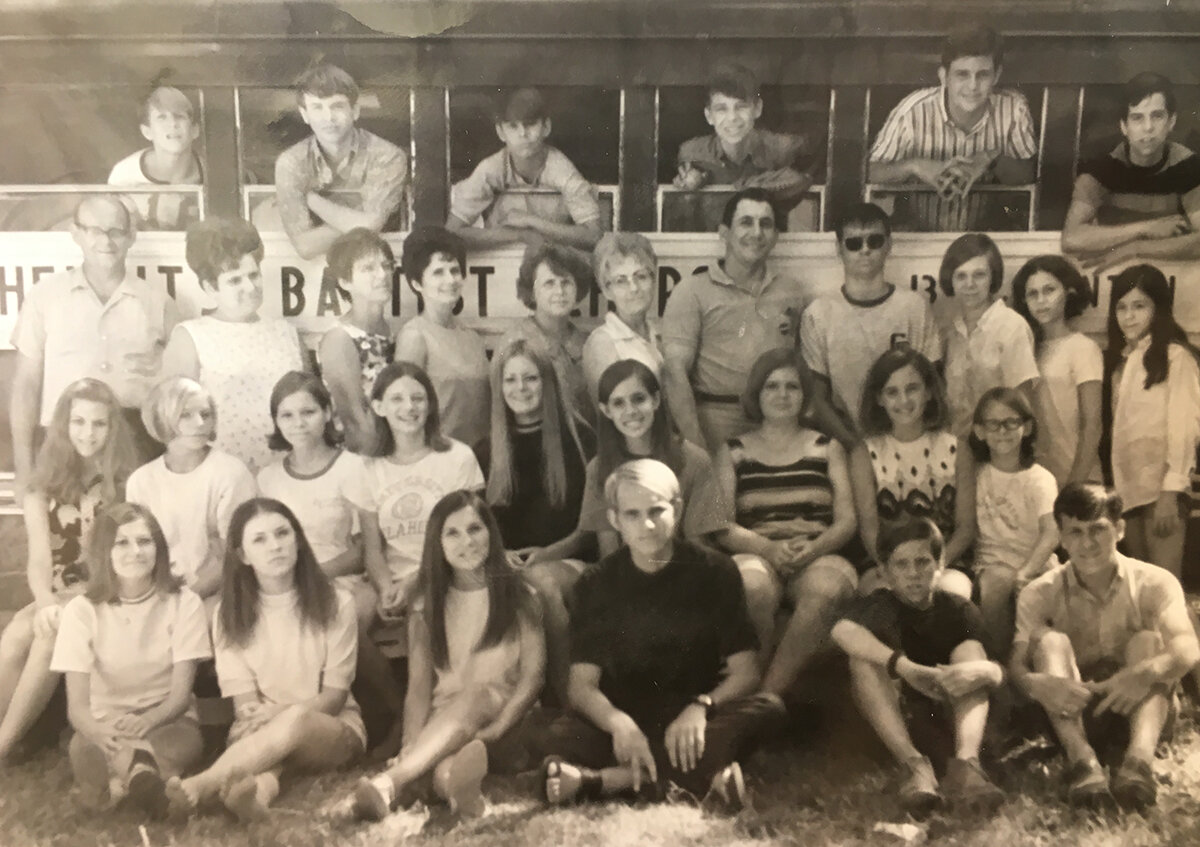
My teenage rebellion pretty much consisted of choosing The Living Bible over The King James, having long hair, playing drums in a rock and roll band, chewing gum in class, flashig a peace sign in the youth camp picture… I’ll wrap up this confessional with: and etc.

IMG_2995.jpg

I’ll admit it now, that at times, I missed the feeling of the familiar words of the KJV when hearing passages like the 23rd Psalm. But this paraphrase called The Living Bible felt, well, alive somehow. In more recent years, The Message version has been the one I read most. I can picture Jesus and those with him talking in words that seem natural and genuine and unpretentious. I realize, it’s all nuanced.

I was reading an article this week and found this worth pondering:

“It is an open question how much Greek of any kind Jesus’s own circle understood or used. Nearly all of the words attributed to them are thus in a language they may never have voluntarily uttered, belonging to a cosmopolitan civilization they may well have despised.”

The author of the article, Casey Cep was quoting Sarah Ruden who has written a carefully translated take on the four Gospels simply titled “The Gospels: A New Translation.”

Cep observes, “Sacred literature is rightfully loved and cherished, but too often that love can creep toward idolatry, shaping the text into something fixed and static, when ideally it is shaping us every time we encounter it.”*

To this day, if asked to quote The Lord’s Prayer, I would do it in the King James Version, just as I learned it so many years ago. It is beautiful. But what if, just maybe, Jesus used a different word or phrase? What if, for example, he said:

Give us day by day tomorrow’s loaf of bread…

Can you feel how powerful that is?! I know it doesn’t seem that different from “Give us this day our daily bread…” But it is!

From her studies of Greek, Aramic and Hebrew and context, that is how Sarah Ruden believes Jesus might have said it. I hope she is right.

Consider it: while it is amazing to be able to ask for our daily bread, how life-changing is it to be able to ask for tomorrow’s loaf of bread today? Imagine being a hungry beggar or child, it’s night and time for bed and you go there with the knowledge that tomorrow’s loaf of bread will be on the table.

It’s nuanced. It’s a glimpse at the possibilities of how we might find fresh perspective and inspiration along the way as our lives develop. Open mind, open hearts, open eyes, open ears. Take a risk. Tomorrow’s bread will be on the table.


*Cep, Casey (April 28, 2021). What We Can and Can’t Learn from a New Translation of the Gospels: Sarah Ruden aims to return familiar texts to the fresh clay from which they were made. The New Yorker. www.newyorker.com